Thursday, August 12, 2010

Oracle-Sun 08/2010 Systems Strategy


Oracle-Sun 08/2010 Systems Strategy

Abstract:
John Fowler, Executive Vice President, had a web conference concerning the systems strategy for the merged Oracle & Sun company. The full PDF of slides was made available. For those who are more interested in systems oriented news, captured [high resolution] screen shots are captured with the interesting highlights.

Solaris Roadmap:
Solaris 11 is coming next year, with multiple upgrades scheduled for the next 5 years.
Solaris Features:
Oracle understands what Solaris is - this is the operating system where if the data needs to be secure and the business must function, this is the advocated direction for the business.
SPARC Trajectory:
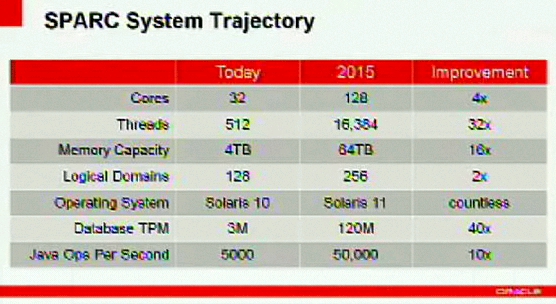
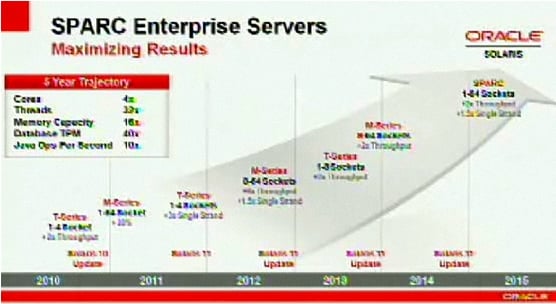
Systems based upon the open SPARC central processors with the Solaris operating system will continue to receive upgrades to deliver performance improvements over the next 5 years.
SPARC Roadmap:
A hardware announcement is scheduled to happen later this year and the roadmap shows a doubling of perforance before the end of the year.
SPARC Direction:
One SPARC architecture, one operating system, one systems management, one virtualization strategy, more memory, more threads, more cores, and system aggregate throughput increases of 2x every 2 years.

Storage Trajectory:
Substantial "order of magnitude" improvements over the net 5 years.
Oracle Storage Roadmap:
Industry leading now, will continue to do so into the future.
Oracle Storage:
Oracle is number 1 or first to market on an increasing number of technologies.
Conclusion:
Oracle is the one to trust and the one who will deliver the goods for the next 5 years!

It will shortly be a very good time to build out a Network Operations Center, to get the most advanced and stable operating system on the latest next generation SPARC architecture.

Wednesday, August 11, 2010

Solaris 11: 2011 Confirmed


Solaris 11: 2011 Confirmed


The Concern:
There has been a lot of concern from the OpenSolaris community about the silence from Oracle. Various community members believed that Oracle was just tying up Solaris 11. A new community based upon internal & external developers started the creation of Illumos in response to the silence. Illumos was discussed in the Network Management blog.


The Confirmation:
Jeff Burt at eWeek attended a live web event at Oracle on Tuesday August 06, 2010 with Oracle Executive Vice President of Systems, John Fowler. Jeff reported that Solaris 11 will be coming in 2011.
Oracle will release the next version of the Solaris operating system in 2011, and will double the performance of its SPARC processors every other year.
Sean Michael Kerner from ServerWatch also attended the live event, reporting the silence in the OpenSolaris community was due to the diligent work going on with the pending Solaris 11 release.
"Solaris 11 will be a superset of what is in openSolaris"... "We've been a little quiet on the open source front," Fowler said. "It's not that we're not investing in Solaris, we're just investing to make sure that we have all the major components for the new release."


The Odd Announcement:
Jeff Burt also reported in his eWeek article that Oracle Enterprise Linux is destined for SPARC?
Oracle will continue to support Oracle VM, its virtualization technology that enables businesses to run Windows and Linux environments—including Oracle's own Oracle Enterprise Linux—on SPARC-based systems.
The meaning of this phrase seems uncertain - one might be wise to wait for the real presentation material and transcript to be made available from Oracle.

Tuesday, August 10, 2010

Sorry Cliff Saran: UltraSPARC T3 Almost Here!


A Very Wrong Prediction


The Bizarre Prediction:
Cliff Saran, the managing editor of ComputerWeekly.com made a terribly bizarre prediction that no one in their right mind could ever consider as reasonable - that the "SPARC roadmap looked dim". How did he come to that conclusion?


The Facts Missed:
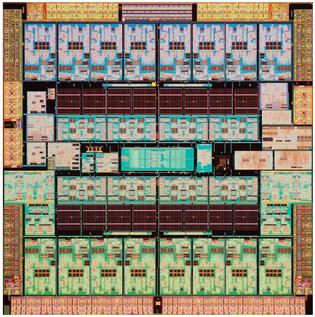
During the Hot Chips 2009 conference, there was a clear description of the architecture for the up and coming UltraSPARC 3 , at that point named Rainbow Falls. There was also a next generation crypto engines presentation. Clearly, had Cliff had not been watching the discussions from February 2010 about the 2 Billion Transistor UltraSPARC T3. Also missed was the code update in OpenSolaris for the official name UltraSPARC T3. Cliff apparently missed the additional code updates from OpenSolaris in July 2010 leveraging the official naming for the UltraSPARC T3.


The Freudian Slip:
Oracle held a web conference today (Tuesday August 10, 2010) talking about the SPARC roadmap, slipped [typo'ed?] a piece of information. Timothy Prickett Morgan covered the announcement from The Register (thanks for the screen shots!) indicating that the current generation of UltraSPARC has 512 threads (which is only possible on an UltraSPARC T3.) It seems like something was only partially redacted from the presentation, since the UltraSPARC T3 in a 4 sockets configuration should offer 64 cores with those 512 threads.


The Revelation:
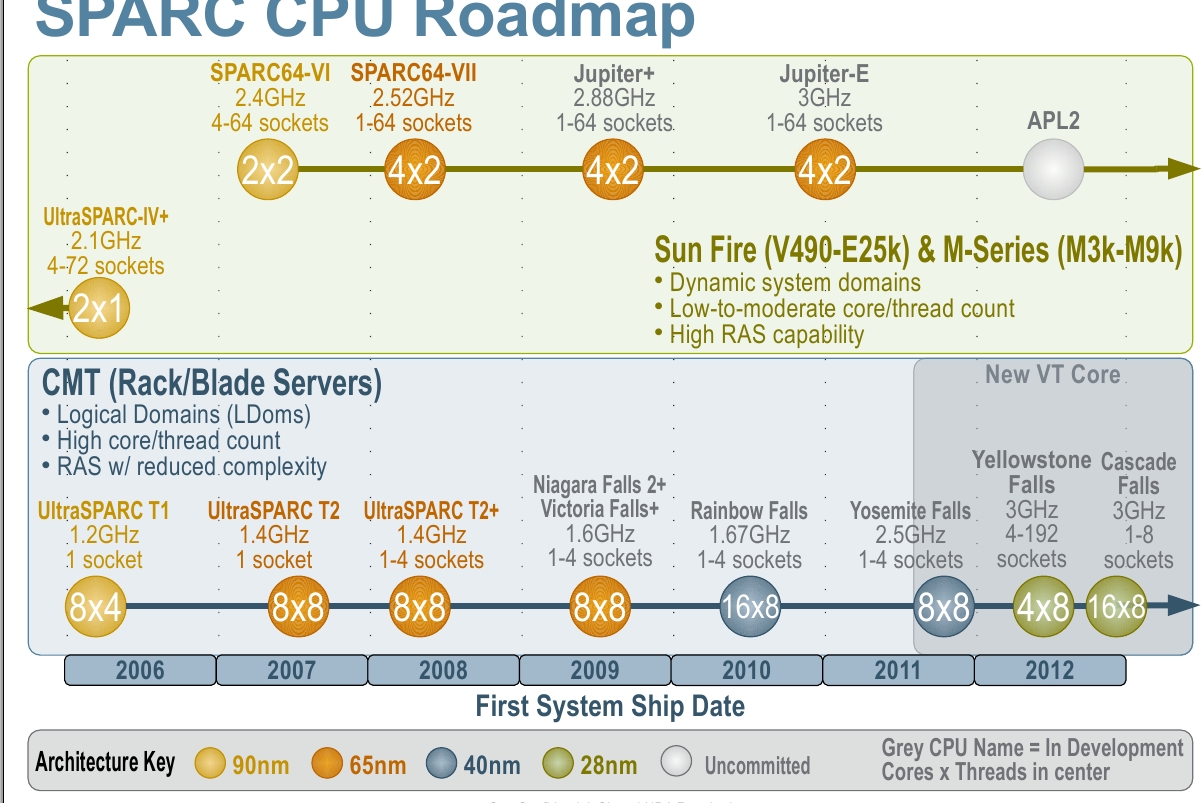
Furthermore, John Fowler (formerly of Sun and now in Oracle) publicly released this rough image detailing the SPARC roadmap for the next 5 years.


The Conclusion:
For an industry managing editor to publish such a bizarre prediction in the headline of an article in his journal, discounting the information ringing in the development circles, and to be so wrong about his prediction just days before a formal announcement... indicates this editor is not an insider who has a tap on reality.

Monday, August 9, 2010

Transferring Files With FTP


Transferring Files With FTP

Abstract:
FTP, with it's mini macro programming language, has been around since the beginning of internet time. It has been used to transfer files around the internet with the avoidance of lower level sockets programming for decades. When transferring files, there is sometimes the question over whether a file has completed it's transfer via FTP on the receiving "ftpd" end. This problem can be mitigate with several best practices so the receiving end can be well aware of when the file being transferred is ready for batch processing through a scheduling facility such as "cron".

Option 1 - Lock Files:
One could ask the initiator create a lock file (send-me.cpio.gz.lock), start sending the data file (send-me.cpio.gz), and then remove the lock file upon completion of the transfer. The cron job can pick it up again once it sees a file where there is no corresponding lock file.

This is helpful for transferring a single file as well as multiple files when that single file was "split" (send-me.cpio.gz.1, send-me.cpio.gz.2, send-me.cpio.gz.3, etc.) Processing for multiple files will not commence until after all the files in the batch have been sent and the lock file is removed.

Option 2 - Suffixes:
A second option is when moving files via FTP, if the sender starts the transfer of the file (send-me.cpio.gz), add a separate suffix to identify that it is in transit (put send-me.cpio.gz.work), and once the file has been sent, the sender should perform a rename of the file in ftp (rename send-me.cpio.gz.work send-me.cpio.gz) The rename is an atomic operation, so cron on the receiving platform can pick up files that do not have a ".work" suffix (or only pick up files which have a ".gz" suffix!)

This option is often very helpful for the occasional transfer of a single large file, where the integrity of the file is important, but people don't want to add too much complexity.

Option 3 - Work Directories:
A third option if one does not want to rename the files, one can always have the initiator place the files in a temporary directory (/temp) and then have the initiator move the file to the production directory (/prod) via their ftp session. The cron job can pick it up only from the production directory since it is known to be completely transferred since the move is an atomic operation.

If there are large numbers of small files which are needed to be transferred, this process is very helpful since occasionally the "inode" may grow aggressively (slowing down the all processing) in the temporary or production directory, requiring an occasional rebuild (rm /temp; mkdir /temp) to resize the inode.

Option 4 - Multiple Files:
A fourth option can deal well with transferring many multiple files (mput) from an initiating system where the receiver wants to process them as they are arriving. If there is a directory holding a large number of files (file1.Z, file2.Z, file3.Z, file4.Z, ...), the initiator can create an additional file with a known suffix (file1.Z.CoMpLeTe, file2.Z.CoMpLeTe, file3.Z.CoMpLeTe, file4.Z.CoMpLeTe, ...), initiate the "mput", and the receiver can have "cron" jobs set up looking for the suffix ("CoMpLeTe"), process the original file name, and upon processing completion, purge the file containing the suffix.

This is especially helpful where transfers may be overlapping from multiple sources with multiple files and the receiving end wants to process the individual files in as close to real-time as possible.

Advanced Automation:
If the senders are newbies to the internet and have worked very little with FTP on the initiating or sending end, there are ways to help them along.

With "ftp", you can build macros on the sending end so the process of logging in, renaming, moving files, creating/removing lock files, or logging out can be reduced to single macro commands, to further remove complexity on the sending end.

The receiver can build the macros and just send them to the people who are the file senders, and the receiver can maintain the ftp macro code, as well. The "ftp" protocol can be used to update those foreign macro files, using a "rename" to swap out the old macro file and an additional "rename" to swap those new macro files into production.

Conclusion:
When there is a need to send files regularly from a source to a destination, the FTP protocol is a good choice when the sender cooperates with the receiver.

Monday, August 2, 2010

More Configuring VNC


The original blog posting on configuring VNC under Solaris 10 is here.

Thanks JayG for some more VNC Configuration options under Solaris!

Illumos, Licensing, Software, Hardware Updates


Illumos, Licensing, Software, Hardware Updates

A New Distribution?

It appears there is a new distribution about to appear for followers of OpenSolaris: Illumos!

Don't miss the project opening!

Solaris Licensing Update

Third party provider terms have been getting re-written with companies such a HP and Dell. Yes, Dell & HP are reselling Solaris with other Oracle items such as Linux and VM. Your Oracle Premier Subscription license here for third-party x86/x64 hardware.

Hats-off to Joerg for his blog post to help sort out the confusion regarding pricing of Solaris under Oracle and non-Oracle hardware.

The short version: if you are running Solaris 10 under Oracle hardware, you get a perpetual license; if you are running Solaris 10 under non-Oracle hardware, you get subscription licensing.

Solaris & Hardware Updates

New hardware releases often accompany new software releases.

NetMgt has been blogging about hints into the next release of Solaris from Oracle in early July as well as next release of UltraSPARC T3 hardware from Oracle in late July - both pointing to September release.

Another hint was blogged by Joerg in early August when he ran into some M3000 XCP 1093 release notes - also pointing to an official September release.

Conclusion

September looks like a pretty exciting time for Network Managment Architects!

Friday, July 23, 2010

UltraSPARC T3: Open Solaris Support


UltraSPARC T3: Open Solaris Support

There is news in the OpenSolaris front: new additions to OpenSolaris and formal naming of the new CoolThreads CPU from Oracle/Sun!


OpenSolaris PSARC/2010/274 is not published, but appeared on Twitter describing a new "-xtarget value for UltraSPARC T3".

For those of you who are unaware, the 16 core with 8 thread per core UltraSPARC T3 from Oracle appears to be the successor to the UltraSPARC T2+ from Sun.

Network Management Tie-In

What does this mean for Network Management?

The Register published a possible SPARC roadmap, showing the a 16 core 8 thread/core processor showing up just after mid 2010, so one might suspect the arrival is close.

Oracle OpenWorld starts September 20, 2010 - so we may have an announcement around then.

If you are building or expanding a NOC, it might be prudent to as for an NDA to determine best purchase time or wait a couple months (if you are a new customer) before striking a purchase, since the high performance UltraSPARC T3 may be just around the corner. Twice the throughput per socket may be worth the wait, if the cost is not significantly higher.