Wednesday, April 2, 2014

Security: Android Phone App Steals CPU

android marketplace shopping bag
[Courtesy: AndroidAuthority ]
Abstract:
Malware was seen traditionally only a Microsoft Windows problem. Now that highly secured,  multi-platform, standards-based UNIX environments lose influence, malware continues to spread to poorly secured Linux environments. More importantly, Google Android's mobile phone and tablet platforms have fallen victim. Attacks continue mercilessly.

old analog time clock
Recent History
Some recent Linux and Android validated attacks: January through November 2013, December 2013, January through February 2014, March 2014, and more malware is hitting the Linux and Android platforms. The most recent attacks are using your Linux based Android phones to create money for others.

virus eating desktop computer
Latest Attack
At the end of March 2014, a new attack was discovered... not only on the third-party Google Android application internet sources, but also multiple infected applications were found on Google Play.

2014-03-26 - Apps with millions of Google Play downloads covertly mine cryptocurrency
Yes, smartphones can generate digital coins, but at a painfully glacial pace.

According to a blog post published Tuesday by a researcher from antivirus provider Trend Micro, the apps are Songs, installed from one million to five million times, and Prized, which was installed from 10,000 to 50,000 times. Neither the app descriptions nor their terms of service make clear that the apps subject Android devices to the compute-intensive process of mining, Trend Micro Mobile Threats Analyst Veo Zhang wrote. As of Wednesday afternoon, the apps were still available.
If you download applications from Google Play or other non-Google sites - you may be noticing terrible battery life, increased battery temperature, and increased network usage.
global network image
What This Means To You
While Google has managed to remove some trojan applications which were designed to steal CPU time from your smart phone in order to electronically harvest bit coins for application developers, there are others sitting in Google Play and in non-regulated application markets.

Wednesday, March 26, 2014

Security: Software Piracy, Android Phones, and SMS Spam


[Courtesy: Android Authority]
 Security: Software Piracy, Android Phones, and SMS Spam
Abstract:
Ever since the creation of computers, people have been distributing software to avoid paying money or paying to distribute something that people don't want. Pirated Applications and Spam are two primary means to distribute viruses, malware, and worms. Baby steps against these on-line monsters are occasionally made.


In Review: 2013

From January to November last year, nearly 2 viruses, trojans, or generic malware was discovered each month in the Android mobile application market. December had a couple more discovered. For the malware discovered, there are countless numbers of mobile applications which have not yet been discovered... to steal credit card information, identities, or even "command and control" applications to turn your mobile device into a robot against unsuspecting targets (while you pay for the data traffic that is produced!)

Starting: 2014

While consolidating a list of mobile malware in the Android market was not completed, it is clear that there is some progress in this space... no matter how small.

2014-03-25 U.S. Government First Convictions Over Pirated Mobile Android Applications
The US has enforced its first convictions for illegally distributing counterfeit mobile apps, after two Florida men pleaded guilty for their part in a scheme that sold pirated apps with a total retail value of more than $700,000. Thomas Allen Dye, 21, and 26-year-old Nicholas Anthony Narbone both pleaded guilty to the same charge - conspiracy to commit criminal copyright infringement - earlier this month and are due to be sentenced in June and July respectively. Both men were in the Appbucket group, of which Narbone was the leader, which made and sold more than a million copyrighted Android mobile apps through the group's alternative online market.

2014-03-26 Chinese Arrest 1,500 in Fake Cellular Tower Text Message Spam Raid
China’s police have arrested over 1,500 people on suspicion of using fake base stations to send out mobile SMS spam. The current crackdown, began in February, according to Reuters. Citing a Ministry of Public Security missive, the newswire says a group operating in north-east Liaoning province, bordering North Korea, is suspected of pinging out more than 200 million spam texts.

In Conclusion:
Be diligent! Remember to purchase your applications from reputable places, don't be seduced into stealing applications on-line or purchasing them under list price. Being a thief could make you a victim!

Tuesday, March 4, 2014

Security: Linux, Viruses, Malware, and Worms

Abstract:
Not long after the advent of The Internet, the creation of worms, viruses, and other malware had become prevalent. Microsoft based platforms were the original serious target, because of poor security measures. Over time, malware had started to attack Linux based Android mobile phones. Now, the latest attacks appear to be hitting Linux based consumer grade internet routers, which were originally used to help protect Microsoft Windows based platforms in the home. These attacks have spiked in the first two months of 2014.


[Huawei TP-Link image, courtesy rootatnasro]
2013-01-11 - How I saved your a** from the ZynOS (rom-0) attack!! (Full disclosure)
Hello everyone, I just wanted to discuss some vulnerability I found and exploited for GOODNESS .. just so that SCRIPT KIDIES won’t attack your home/business network .
Well, in Algeria the main ISP ( Algerie Telecom ) provide you with a router when you pay for an internet plan. So you can conclude that every subscriber is using that router . TD-W8951ND is one of them, I did some ip scanning and I found that every router is using ZYXEL embedded firmware.


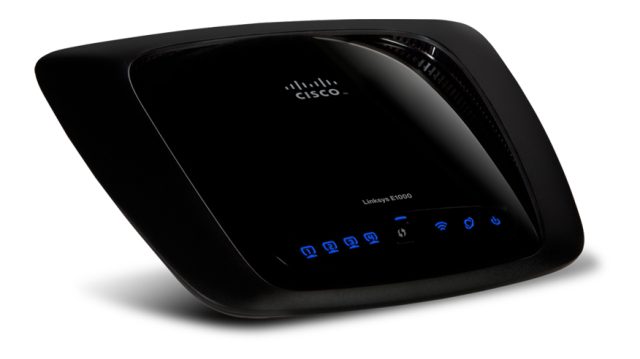
[Linksys Router, courtesy ARS Technica]
2014-02-14 - Bizarre attack infects Linksys routers with self-replicating malware
Linksys is aware of the malware called “The Moon” that has affected select older Linksys E-Series routers and select older Wireless-N access points and routers. The exploit to bypass the admin authentication used by the worm only works when the Remote Management Access feature is enabled. Linksys ships these products with the Remote Management Access feature turned off by default. Customers who have not enabled the Remote Management Access feature are not susceptible to this specific malware. Customers who have enabled the Remote Management Access feature can prevent further vulnerability to their network, by disabling the Remote Management Access feature and rebooting their router to remove the installed malware. Linksys will be working on the affected products with a firmware fix that is planned to be posted on our website in the coming weeks.


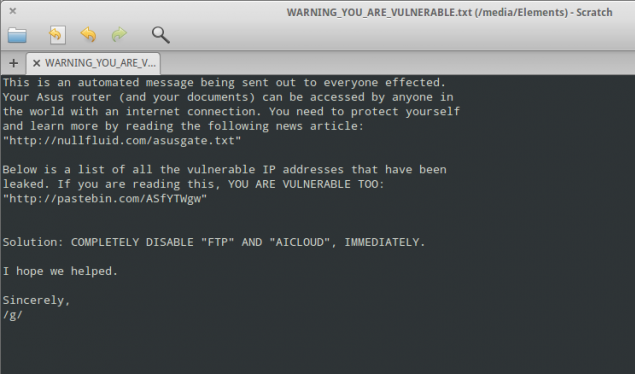
[ASUS Warning, courtesy ARS Technica]
2014-02-17 - Dear Asus router user: You’ve been pwned, thanks to easily exploited flaw
"This is an automated message being sent out to everyone effected [sic]," the message, uploaded to his device without any login credentials, read. "Your Asus router (and your documents) can be accessed by anyone in the world with an Internet connection. You need to protect yourself and learn more by reading the following news article: http://nullfluid.com/asusgate.txt."
...
Two weeks ago, a group posted almost 13,000 IP addresses its members said hosted similarly vulnerable Asus routers.


Conclusions:
If you are doing any serious internet based work, one might suggest that care is taken to watch the firmware of your consumer grade internet router, and upgrade the firmware as they become available. If you are running a business, a commercial grade router with a managed service may be of special interest. A short PDF on "SOHO Pharming" helps clarify risks. The avoidance of Linux based Android phones or consumer grade Linux routers may be the next best step.

Friday, January 17, 2014

Security: Android, Viruses, Malware, and Worms


[Courtesy AndroidAuthority]

Android: Malware Infestations for 2013

2013 Ending
Rounding out the 2013 Year with More Android Virus and Malware issues.


Somehow, this is no surprise.

2013 Investigation
A previous Network Management article discussing Android Malware from 2013 - not a pleasant place to be. Nearly a new Android exploit was uncovered every 2 weeks.

2013 Conclusions
A recent article in The Register mentions the dangers of Java and Android (which is based upon a Java port) on network clients:
Meanwhile, fully 99 per cent of all mobile malware discovered during the year targeted Android, as did 71 per cent of all web-based attacks on mobile devices.
Android mobile devices are less expensive than the alternative - but there is clearly a price to be paid.

EMC Smarts: Watch4Net APG Data Purging


A short note about default behavior within EMC Smarts Watch4Net APG
How to delete a device in Watch4Net. 
With default settings, APG will delete a device (or one of its component) and its history if it’s not updated for 1 full year. However, for some reason, you may want to manually override this behavior without changing the automated configuration. APG provides a tool that allows you to delete data from the database. It’s only available to administrative users, in the “Administration” pane and it’s called “Management of APG Metrics”. To use this tool, you have to:
• Set a filter to select the data to delete
• Type in the maximum number of results
• Check whether or not the last timestamp is displayed
• Select the properties to show
• Then, click the “Query” button
• Results will appear in the box below
• Last, just click the “Delete” button to delete all these data from APG 

There is no out-of-the-box way to de-provision from the command line.
Conclusions:
If a site runs out of licenses, the GUI may crash and refuse to remain running... a very poorly written application result - but hey, EMC is not supporting high-end platforms like Solaris any longer, so what can you expect? Make sure you have spare licenses within Watch4Net to handle customer on boarding and off boarding - otherwise you may have some unexpected results!

Monday, December 30, 2013

Security: A Linux Server Exploit


Why do people want to hack your server? Maybe it is to mine BITCOINS!
http://arstechnica.com/security/2013/12/anatomy-of-a-hack-what-a-successful-exploit-of-a-linux-server-looks-like/
Like most mainstream operating systems these days, fully patched installations of Linux provide a level of security that requires a fair amount of malicious hacking to overcome. Those assurances can be completely undone by a single unpatched application, as Andre' DiMino has demonstrated when he documented an Ubuntu machine in his lab being converted into a Bitcoin-mining, denial-of-service-spewing, vulnerability-exploiting hostage under the control of attackers.


Wednesday, December 25, 2013

Processor War: Google to Manufacture ARM?


[Datacenter Image, courtsy ARS Technica]
 Google maybe thinking about making their own ARM central processing units
http://arstechnica.com/information-technology/2013/12/report-google-contemplates-homemade-arm-chips-to-power-its-servers/
We've already seen consumer technology companies like Apple and Samsung become more vertically integrated in the last few years—Apple designs its own phones and tablets, the chips that go in them, and the architecture that goes into the chips, for example. Just as Apple's software benefits from tight integration with Apple's hardware, Google is reportedly eyeing chip design as a way to "better manage the interactions between hardware and software."

[Sun Microsystems Logo]
Of course, Sun (and now Oracle), have seen a similar benefit with SPARC, over the years. Sun Microsystems was able to drive volume in their market, but as manufacturing costs rose, the market needed to grow accordingly. The UNIX market had found ways to differentiate themselves from the consumer market, but that market shrank as the consumer market canibalized it. There needs to be a large enough market to make the investment profitable in this high-cost and high-risk arena.


[Sun Ray Terminal]
Google is large enough, to make such an investment profitable, and they have a large enough investment in ARM hardware software with the Mobile consumer market. This does not guarantee survival, however, as Oracle demonstrated their desire to exit the desktop appliance market with the discontinuing of their Sun Ray product, when they could have invested in SPARC or ARM for the Sun Ray to make an additional consumer for their SPARC processor investment, hedge the investment in SPARC processor in skilled programmers, and created a new market driver for Oracle's Cloud offering using Sun Ray appliances.