
Showing posts with label HP. Show all posts

Sunday, March 8, 2015

HP Acquires Aruba Wireless Infrastructure

[HP Logo, Courtesy Wikipedia.org]
Abstract: 
Hewlett-Packard Company, created in a garage by two electrical engineers in Palo Alto, California, started their company through the creation of superior test equipment. Through organic and acquisition means, HP had grown into consumer and enterprise markets, ranging from printers, to PC's, to mini-computers, networking equipment, and software. They are preparing to split into two different companies, one based upon consumer equipment and another based upon enterprise equipment. Prior the split, HP is filling gaps in their networking portfolio.
[Huawei-3Com Partnership Logo]

Road to Aruba:
On September 26, 2014, HP announced the launch of a Software Defined Networking Application Store.  acquisition of a Software Defined Network company. October 5, 2014 marks when HP announced the split between HP, Inc (for printers & desktops) and Hewlett-Packard Enterprise (for networking, server, and software.) Just days later, October 26, 2014,  HP decided to find a buyer for H3C, the networking partnership between Chinese based Huawei and U.S. based 3Com which HP received when 3Com was acquired in 2010. Clearly, HP is committed to filling out their networking portfolio in the Enterprise company while culling some partnerships..

[Aruba Networks logo, courtesy Wikipedia]
Aruba Not Soon Enough:
March 2015, HP announces the acquisition of Aruba, wireless network provider, filling a gap in their Networking portfolio, prior their corporate split between Desktop/Printer and Enterprise. Hewlett-Packard's networking division was experiencing some pain, according to The Register.
The deal will form a welcome plug to HP's sliding network biz, which fell 10.8 per cent to $562m (£365m) in the company's first quarter results last week.
Aruba posted sales of $729m (£473m) for its full year results in 2014. In its second quarter numbers last week, revenue rose 21 per cent to $212.9m (£138m) and net profit came in at $5.6m versus a net loss of $10.7m in the same quarter a year earlier.
With larger quantities of networking moving from wired to wireless, the new growth area must be accounted for in Hewlett-Packard's portfolio. The Aruba Networking acquisition is expected to be complete in Hewlett-Packard's second quarter.
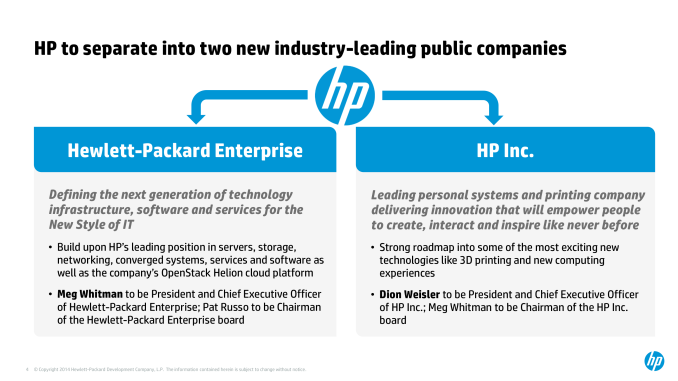
[HP Split Image, courtesy Anandtech]

Divide and Conquer:
This is not the first split, for HP - Agilent Technologies was created when the Test Equipment division was spun-off 1999. The split of Printers and PC's, to form HP, Inc., should complete in October 2015. The PC and Enterprise markets are very different, requiring significant management style differences... the former requiring very short innovation cycles while the later demands long-term viability of a product with significant investment with close attention to security. Aruba should make an excellent contribution to the portfolio.

Conclusions:
Hewlett-Packard Company was also famous for Network Management products, such as the formerly branded OpenView suite, which dominated the market during the 1990 as the Internet was aggressively expanding. HP's former OpenView suite consolidated into HP Software Division will find a very good home, in the new Hewlett-Packard Enterprise with Network Equipment vendors like Aruba. The combined 3Com, HP Networking, and Aruba portfolio will offer a reasonable platform for the Enterprise company, while the existing established Network and Systems Management suites will provide a software layer to unify the equipment for basic Fault, Performance, and Configuration Management in the Managed Services arena.

Thursday, April 17, 2014

Hardware: American Sell-Off with IBM and Google

[IBM Logo, courtesy IBM]

Abstract:
As the misguided U.S. economy continues to run up massive debt and continue massive trade deficit, the sell-off of U.S. High Technology assets continues to non-U.S. companies, fat with outsourcing cash. Lenovo, a Chinese company, continues their purchases in the United States of inventors of technologyu.
[Chinese glorifying revolution, courtesy, The Telegraph]
Chinese Lenovo Purchasing U.S. Hard Technology

Chinese global company Lenovo has been purchasing their way into the U.S. market through many technologies essentially invented in the United States. IBM seems to be the most significant seller.

[IBM PC, courtesy Wikipedia]
  • 2005-05-01 - PC Division acquired from IBM (PC's and ThinkPad Laptops)
    Chinese computer maker Lenovo has completed its $1.75 billion purchase of IBM’s personal computer division, creating the world’s third-largest PC maker, the company said Sunday. The deal — one of the biggest foreign acquisitions ever by a Chinese company
    [IBM Thinkpad, courtesy tecqcom]
  • 2006-04-10 - Lenovo makes break with the IBM brand (on PC's, not ThinkPad Laptops)
    Since Lenovo took over the IBM personal computer business on May 1, 2005, the company's advertising and marketing efforts have excluded IBM almost entirely. The four television spots that Lenovo ran during the Turin Winter Olympics, for example, never mentioned IBM at all. In fact, the only connection to the iconic brand is the IBM logo, which still adorns Lenovo's ThinkPad laptops.
  • 2013-01-07 - Lenovo to create ThinkPad-focused business unit to compete at the high end
    Lenovo is reorganizing its operations into two business groups... As part of the restructuring, it will create two new divisions, Lenovo Business Group and Think Business Group.The reorganization, which will be completed on April 1 [2013]
    [IBM Servers, courtesy Wikipedia]
  • 2014-01-23- Lenovo to buy IBM's x86 server business for $2.3bn (PC Servers)
    Lenovo and IBM announced on Thursday they have signed a definitive agreement that will see the Chinese hardware giant acquire the IBM's x86 server business for the tidy sum of $2.3bn, with approximately $2bn to be paid in cash and the balance in Lenovo stock.
    Adding to the PC business Lenovo acquired from IBM in 2005, Lenovo will take charge of IBM's System x, BladeCenter and Flex System blade servers and switches, x86-based Flex integrated systems, NeXtScale and iDataPlex servers and associated software, blade networking and maintenance operations.
    [Motorola Droid RAZR, courtesy Wikipedia]
  • 2014-01-29 - Motorola Cellphone Company acquired from Google (by Lenovo)
    Lenovo has signed a deal to buy the loss-making Motorola Mobility smartphone manufacturer for $2.91bn, but a switched-on Google is keeping the patents owned by the firm it gobbled two years ago for $12.5bn.
    "The acquisition of such an iconic brand, innovative product portfolio and incredibly talented global team will immediately make Lenovo a strong global competitor in smartphones," said Lenovo's CEO Yang Yuanqing. "We will immediately have the opportunity to become a strong global player in the fast-growing mobile space."
  • 2014-01-29 -  Lenovo splits into 4 groups after buying IBM's server business
    A few days after announcing its plan to buy IBM’s x86 server business, the Chinese company is dividing its operations into four business groups... enterprise products... developing a software ecosystem...PCs and mobile products. The changes go into effect on April 1 [2014]
Clearly, Lenovo has a vision for the U.S. Market and is executing upon it. How unfortunate that American companies such as IBM and Google see little value or possibility in domestic hardware innovation, moving into the future.
[HP Logo, courtesy eWeek]
Impacts in the U.S. Market

There is a great deal of uncertainty felt by partners and customers of IBM through such acquisitions. Previous attempts to leverage the IBM logo to help assure customers was performed, but with the latest purchase - competitors such as HP are seeing the a lot of noise.
  • 2014-04-11 - HP: Lenovo's buy of IBM x86 biz is bad, bad, bad...
    "Customers and partners are concerned. They are concerned about what the future will be for them – not only in the product but also in support and services," claimed the exec veep and GM of the Enterprise Group.
    HP has an internal migration programme to support customers with IBM servers as they decide to make the switch, he pointed out.
    But providing maintenance support is something that HP and other vendors already offer on third-party kit as standard.
HP was tried to consolidate all of their computing systems under Intel Itanium, before trying to shut them all down. HP also tried to sell off their PC business, but relented, possibly due to customer pressure. How conservative customers who would only buy IBM will respond in the U.S. to their favorite manufacturer leaving the industry may not be a difficult conclusion to reach, especially from companies like HP.
Concluding Thoughts:
The massive technology bleed from the United States is partially due to commoditization, but also due to the migration to Cloud and Appliances and value provided by Intel computing vendors becoming less significant with Intel shipping entire motherboards bundling CPU, Floating Point, Memory Management Units, Ethernet, and most recently Video. Cell phones appear to be drastically simplifying, as well. Perhaps there was nothing of value left for Intel or cell phone based manufacturers to do? Can Apple buck the trend?


Friday, December 20, 2013

ARM: Calxeda Runs Out of Money

[Calxeda ARM processor, courtesy ComputerWorld]
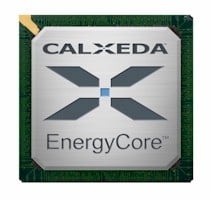
The developer of 64 bit ARM processors closed down, the week before Christmas. Calxeda is going through restructuring. The world may still see a 64 bit ARM from this company, yet. Previously, their 32 bit ARM processors were well received by the market. In 2011, Calxeda announced the development of a 480 core low power server, to be consumed by Hewlett Packard. The "Moonshot" servers from HP may be negatively impacted - HP's attempt at resuming RISC processor platform production may be in chaos.

Thursday, February 21, 2013

Itanium: Another Step Closer to Death

Itanium: Another Step Closer to Death
Abstract:
Intel had produced the Itanium architecture to compete in the higher-end 64 bit arena and eventually sun-set their aging 32 bit x64 architecture. With the release of AMD's x64 architecture, and vendors such as Sun Microsystems abandoning the Itanium roadmap for AMD x64 - pressure was placed upon Intel to include 64 bit instructions in the x86 chipset. Now with Intel x86 supporting 64 bit processing, there is little reason for Itanium to exist, placing pressure on remaining Itanum system vendors.

[Artist depiction of the Sinking of the Titanic]

Intel Itanium: The Sinking Chip
In 1999, Sun started a port of Solaris to Itanium, but it was Solaris support for Itanium was abandoned 2000, was considered again in 2004, but abandoned. Itanium servers were dropped by IBM in 2005. Dell kills Itanium servers in 2005. CentOS drops Itanium support in 2007.  In 2009, NetMgt reported that Red Hat killed support for Intel Itanium. in 2010, Microsoft Network Management reported Microsoft killed support for Intel Itanium. Gelato ends Linux on Itanium in academic HPC environments. Oracle dropped future Intel Itanium development in March 2011, but HP sued. Network management published in March 2012 that it became clear in court proceedings that Oracle was right, Intel Itanium is dead, but Oracle had to provide software support, anyway.

HP Wins & Loses:
After winning a lawsuit against Oracle, Intel announces plans to slow Itanium development. Itanium will not receive the newer socket update, to capture newer hardware features, but will merely receive an in-socket speed-bumb.
PC World has just noticed an Intel posting from late January, saying that Kittson would remain socket-compatible with the current Itanium 9300 and 9500 CPUs. Sticking a new processor in an older motherboard can still yield speed improvements, but you'll miss out on new, chipset-dependent advancements—support for faster RAM, newer RAM standards (like the upcoming DDR4), and new versions of PCI Express, SATA, and USB, among other thngs.
Clearl, HP is in a world-of-hurt. New Itanium servers are not coming.

[Itanium & Inspur image, courtesy The Register]
Itanium: Moving to China?
In April 2011, Chinese announce plans to build servers on Itanium. Huawei and Inspur announce plans to build Itanium servers. What OS will those servers run - is HP it the only owner of an OS on Itanium? One can't imagine that HP will share it's OS with a hardware competitor, unless they plan on abandoning the hardware market for Itanium, and charging them an OS fee. Will HP become an OS vendor? Perhaps HP will sell OpenVMS through them?

Conclusions:
It may have been better for HP to purchase Sun SPARC & Solaris, to migrate their Itanium systems over to SPARC, instead of letting Oracle get the entire company. HP clearly needed something to save itself from the sinking of Intel Itanium, Oracle knew it, and it looks both Oracle & HP were pretty close to a deal that would have saved HP customers from a lot of hurt.

Sunday, December 9, 2012

Made in the U.S.A.

Tim Cook 1979Apple CEO Tim Cook 2012

Made in the U.S.A.
Abstract:
In a recent interview with the Apple CEO Tim Cook, thanks to The Register for the pictures, there was a short discussion on asembling computer systems in the United States. There have also been short articles on which systems are being manufactured closer to the nation of purchase. Debunking of false 1st world manufacturing drivers as well as industry stated drivers for 1st world manufacturing will be reviewed. The United States is not the only nation which will benefit from distributing manufacturing capabilities outside of large 3rd world manufacturing facilities, so they are also worth the discussion.

North America, courtesy: The Lonely Planet
Home of Manufacturing:
When the United States was a mere "colony", most of the manufacturing was done in England. Much of this started to change during the Industrialization of America. The most significant sweeps in manufacturing, perhaps occurred during World War 1 and World War 2, when so much of the manufacturing capacities around the world were destroyed.

Honestly, I don't remember anything being manufactured in the United States in recent time, except building materials. Of course, wood based product are increasingly being produced in South America, and dry wall is being increasingly produced in China. A recent trip to Home Depo had made me realize this - and helped me to understand that the next building-boom will not necessarily drive U.S. industry.

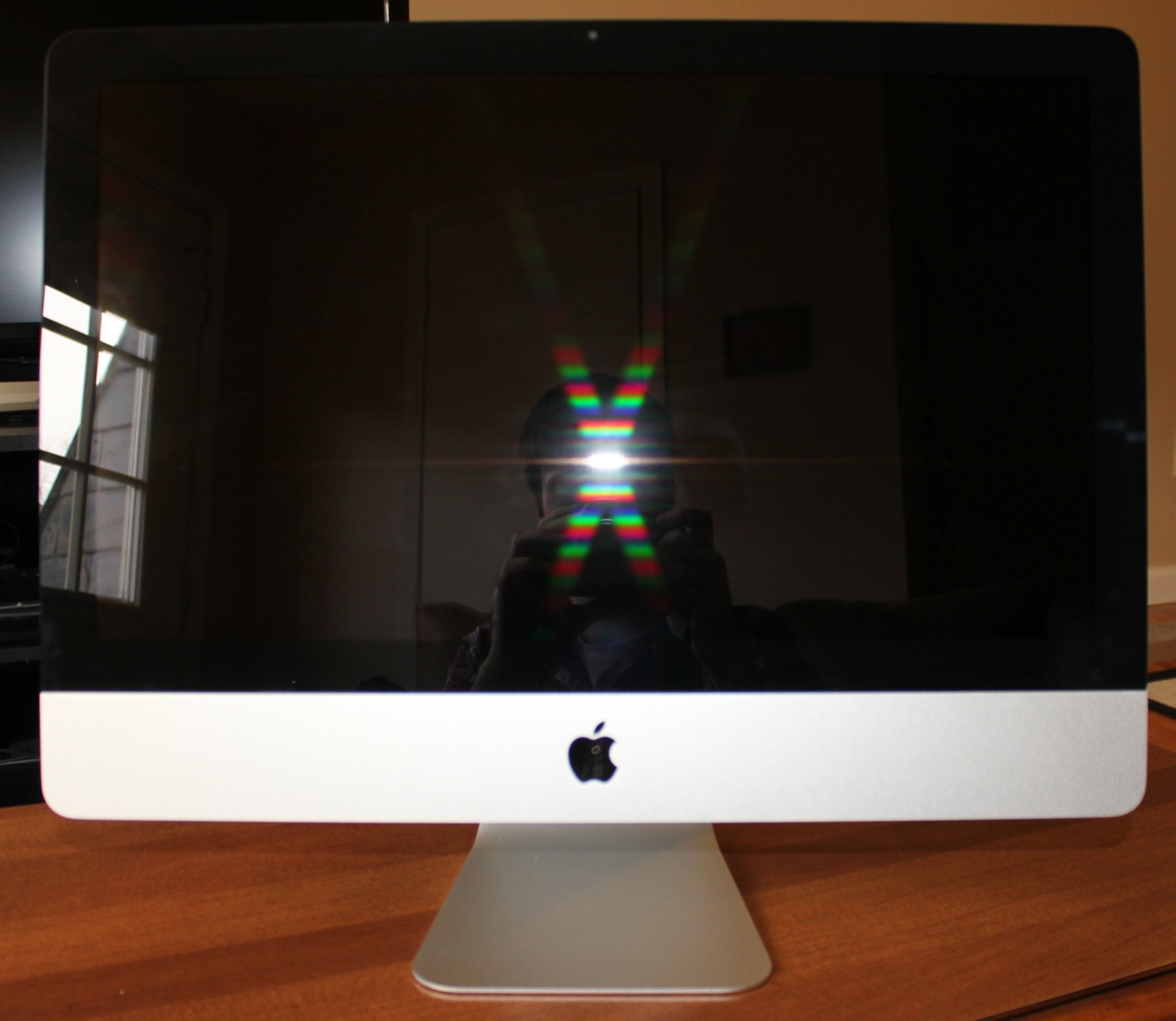
Apple 2012 21" iMac, courtesy The Register
Manufacturing Consumer Electronics:
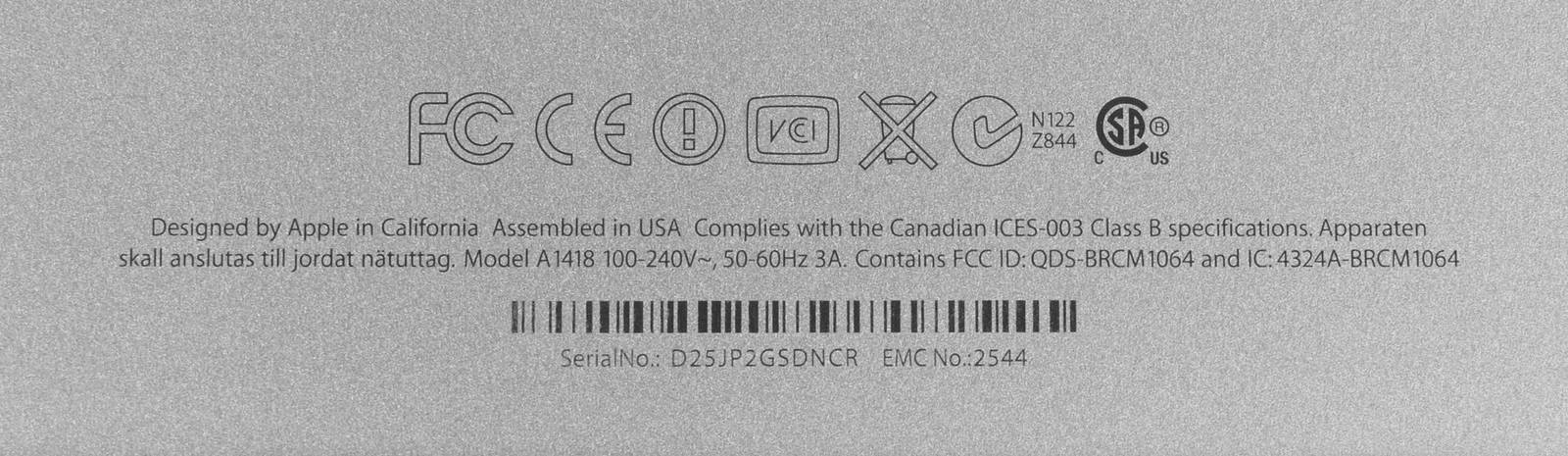
During the "tead down" of a 2012 21" iMac, it was noted that the consumer product was assembled in the United States. People have mentions that 2011 Apple iMac's have been assembled in the U.S.A., as well as Mac Pro in 2007, a Mac Mini in 2006, as well as a decade-old Apple Macintosh G3. Computer World mentioned the 1999 Power Mac, the first iMac in 1988, and even the two decade old Apple II.

One of the most interesting quotes from Apple CEO was in regard to manufacting of Apple consumer electronics:
"It's not as much about price," he said, "it's about the skills, etcetera. Over time there are skills that are associated with manufacturing that have left the US."
And in Apple's market, according to Cook, those skills weren't here to begin with. "The consumer electronics world was really never here," he said, "and so it's not a matter of bringing it back, it's a matter of starting it here."
Remembering former CEO of Apple, Steve Jobs, when he was "fired" from Apple, he started a new computer company called "Next", in the 1980's. During that time, they assembled computer systems in an office - but they could never keep up with the demand. Next turned into a "software company" and was later re-purchased by Apple. Computer World may have presented the argument for consumer electronics best:
Cook's announcement was both a recognition of real-world manufacturing and a bit of a departure from former CEO Steve Jobs' opinion. In a meeting with President Obama in 2011 just months before his death, Jobs reportedly said, "Those jobs aren't coming back," when the President asked what it would take to make iPhones in the U.S.
How will Apple bring more manufacturing to the United States? Well, apparently Apple does not have the know-how to do it themselves, at an economically feasible cost.
Cook said that Apple will invest more than $100 million in the project -- pocket change for a company that has over $120 billion in the bank -- but that it wouldn't do it themselves. "We'll be working with people, and we'll be investing our money," he said.
In essence, Tim Cook was right - manufacturing in the United States was, and still is, a difficult endeavour. Regulations are a huge issue, perhaps even a liability issue, that Apple does not feel comfortable dealing with on a larger scale.
Apple 2011 iMac, courtesy arstechnica

More than Apple?

It seems more computer manufacturering is happening outside of China. A recent article from the New York Times mentions:

Five years ago, he says, H.P. supplied most of Europe’s desktops from China, but today it manufactures in the Czech Republic, Turkey and Russia instead. H.P. sells those kinds of computers particularly to business customers.
While not the cost structure of "first world" manufacturing, it is still interesting.
Dumb Reporter for New York Times, courtesy calvinayre
Bogus 1-st World Manufacturing Drivers
What exactly drives manufacturing, some may ask?

The notorious New York Times suggests:
Today, rising energy prices and a global market for computers are changing the way companies make their machines.
Immediately after making this statement, they went on to use computer consumption in Europe as s supporting argument, which immediately destroys half of the original statement, since Europe is a First World nation and had always consumed computers, thus this "global market" had not changed, from a consumption perspective. This only leaves Energy.

Also in the same article, The Times mentions:
In 1998, President Bill Clinton visited a Gateway Computer factory outside Dublin to cheer the role of American manufacturers in the rise of a “Celtic Tiger” in technology. That plant was shut in 2001, when Gateway elected to save costs by manufacturing in China.
Energy was at its lowest point during the Clinton years, and started to rise during the G.W. Bush years, so cheap to rising cost of energy was part of the equation to outsource to China. Energy costs are higher in the 1st world than in the 3rd world, where reduced regulation means more plentiful energy at a lower cost.

If The New York Times can't present a cohesive argument, then what are the incentives?

The Main Drivers for 1st World Manufacturing:
The previous New York Times article mentioned some cohesive points on locality of components.   Manufacturers who have major components produced in the 1st world may find advantageous assembly in the 1st world. For apple, the following proves interesting:
Intel, which makes most of the processors, has plants in Oregon, Arizona, New Mexico, Israel, Ireland and China. ... The special glass used for the touch screens of Apple’s iPhone and iPad, however, is an exception. It comes primarily from the United States.
However, for cheaper [Android] phones, hand-held games, and laptops, the opposite seems to be the case, manufacturing may never come to the 1st world again:
Many other chip companies design their own products and have them made in giant factories, largely in Taiwan and China. Computer screens are made in Taiwan and South Korea, for the most part.

Time to Market is a huge benefit for one Chinese manufacturers. ComputerWorld also mentioned China's Lenovo manufacturing of laptops in North Carolina in October 2012:
The company, which is based in China, earlier this month announced it would open a factory to make computers in Whitsett, N.C. -- its first such facility in the U.S.
...
Manufacturing in the U.S. will help Lenovo get its products to customers more quickly, said Peter Hortensius, senior vice president of the product group at Lenovo...The company will manufacture ThinkPad laptops and tablets starting early next year, and with the new factory, Lenovo hopes computers could reach customers within a week, or in some cases, overnight. But initial supplies of products like the ThinkPad Tablet 2, which will become available in October, will not be made in the U.S. factory.
...
Many Lenovo computer shipments originate from China and are supposed to reach customers in 10 days, but in some cases take weeks. The company also has factories in Japan, Brazil, Germany and Mexico.

The same article in ComputerWorld also dicusses Lenovo's desire to appear to patriotism for market penetration:
The "Made in USA" tag on computers manufactured in North Carolina will resonate with some buyers
In some cases, it may be tax incentives, but The New York Times suggested that is not enough, by placing the failure in the same sentence as the reason.
A Dell factory in Winston-Salem, N.C., for which Dell received $280 million in incentives from the government, was shut in 2010 (Dell had to repay some of the incentives).
 
There are clearly drivers for 1st world manufacturing.

President Obama, courtesy Carnagie Mellon School of Computer Science
How Many Jobs?

This is always the question. Perhaps, this is best mentioned at the end of the New York Times article...
As cheap as a Chinese assembly worker may be, an emerging trend in manufacturing, specialized robots, promises to be even cheaper. The most valuable part of the computer, a motherboard loaded with microprocessors and memory, is already largely made with robots.
The ultimate answer is, there are not many good high-wage jobs in manufacturing any longer. This was painfully made clear during President Obama's campaign tour across the country - everywhere he went, he talked about manufacturing.
U.S. Manufacturing Jobs during Obama Presidency, courtesy The American Thinker
The American President tried to defend his stagnant economic growth for 4 years, now starting his second term, and the only thing which is clear: while manufacturing is now basically stable, Obama may have stopped the bleeding, but there are fewer manufacturing jobs in the United States than at any point during the previous President G.W. Bush's administration.

Computer manufacturing will not bring it back.

Wednesday, July 11, 2012

Architecture Update: The ARMs Race


Abstract:
With the explosion of ARM processors in embedded systems, ranging from phones to tablets, ARM designers are creating ever more complex processors, CPU manufacturers are creating more options for system designers, and even system designers are discussing the movement of ARM from embedded to server and desktop systems.

CPU Architecture

64 Bit ARM v8
First, let's discuss the CPU architecture updates to the ARM processing architecture. Traditionally, the ARM processor bundled a 32 bit processor. While this was more than adequate for embedded systems, this limited the application of the architecture into other spheres of computing.


At the ARM TechCon conference in Santa Clara, California, in October 2011 - the ARM v8 64 bit architecture was announced, demonstrating 64 bit extensions similar to what was done with SPARC, AMD, and later Intel CPU's.

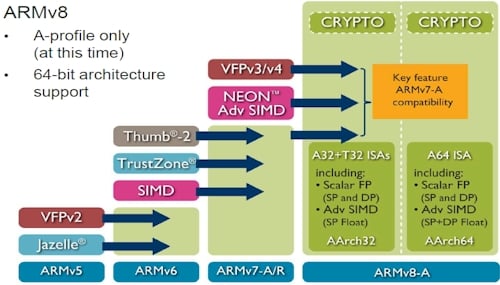
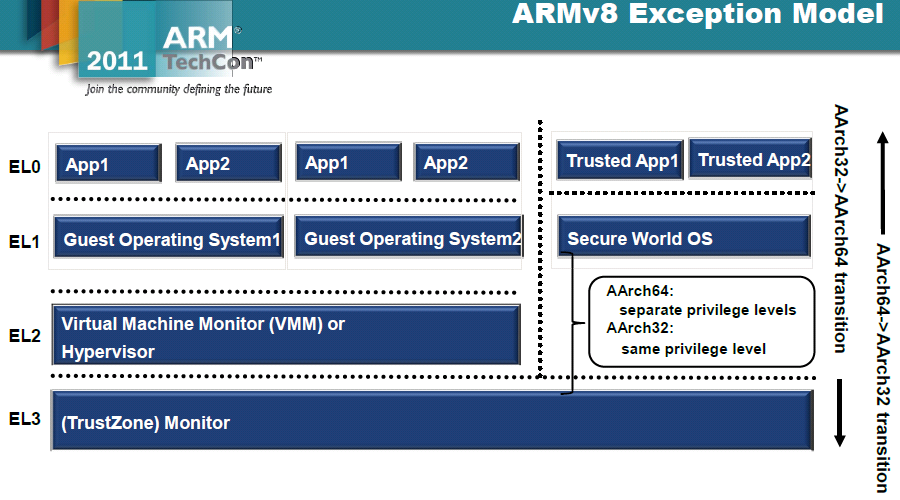
The new ARMv8 architecture has two execution states, the AArch32 state that is compatible with prior generations of 32-bit ARM processors, and AArch64, the new 64-bit extensions. At the moment, the ARMv8 architecture has only been profiled for what ARM calls the A line of its Cortex reference designs, which means they are designated for application processing such as that done on smartphones and tablets.
The ARMv8 architecture will bring forward TrustZone virtualization (which debuted with the ARM v6) and NEON SIMD instructions, which debuted with the ARM v7 designs. The interesting thing about the ARMv8 is that it will offer both double-precision floating point math through that NEON unit.
ARM Update: Mali 450 GPU moves from 4 to 8 cores

The Registered published a short article about an ARM roadmap split:
ARM is doubling the punch of its Mali 400 graphics processors with extra cores for tablet, phone and TV makers that are not ready for combined graphics and compute chips.
The microprocessor architect has announced the Mali 450 GPU, featuring eight cores instead of four.
ARM said the 450 showed it remains committed to the 400 range, and said it is now splitting its roadmap.

ARM Designs Quad-Core 32-bit v7
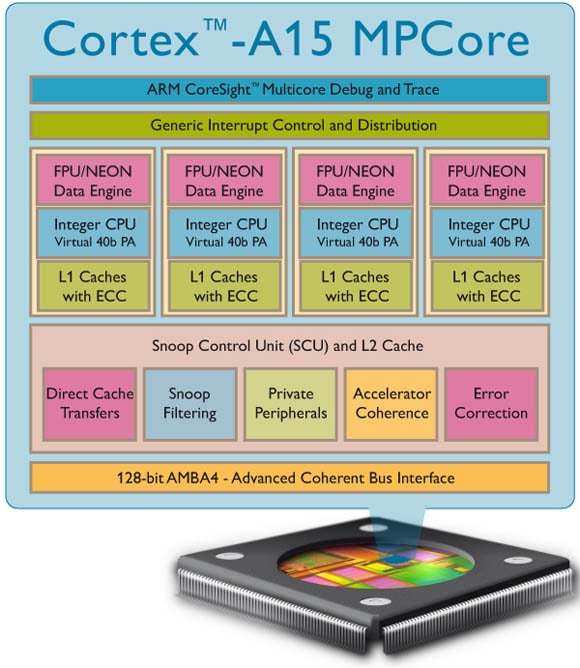
In April of 2011, ARM announced their quad-core Cortex-A15 processor was scheduled to appear in smart phones or tablets in 2012-2013.
ARM's Cortex-A15, however, will up the ante with an out-of-order superscalar pipeline, 40-bit memory-addressing capabilities, floating-point and media-handling improvements, and a clock speed of up to 2.5GHz, all at power requirements said to be comparable to the company's current Cortex-A9 design.
The Cortex-A9 is the design upon which such top-end smartphone and tablet chips as Apple's A5, Nvidia's Tegra 2, and Samsung's Exynos 4210 are based. The Cortex-A15 design, meanwhile, has already been licensed by Texas Instruments and Nvidia, and Nvidia

(ARM v8 Exception Model, courtesy ARMv8 Architecture PDF)
ARM Starts Designing 64-bit
Richard Grisenthwaite, Lead Architect at ARM, provided a technology preview of the ARMv8 64 bit architecture at ARM TechCon in 2011. It was clear from the document that 32 bit ARM processors would continue to be designed and that this was merely a new line of processor design which manufacturers could leverage.

System Designers


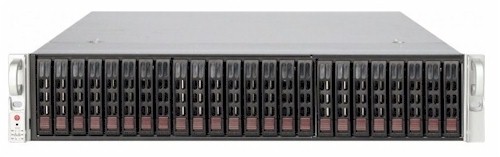
(A Boston Viridis server, front view, no cover, courtesy, The Register)

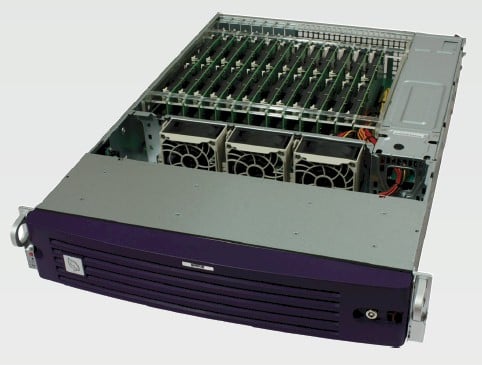
(Boston Limited's first Viridis server, courtsy The Register)


Boston
The Register writes about U.K. IT Supplier Boston is releasing their Viridis platform, based upon their Calexeda partnership, using the Smoothstone ARM processor.
"The Viridis server is using the 1.4GHz variant of the ECX-1000 processors and plunks a 4GB DDR3 memory stick in for each node on the card. The card has two 10GE network ports and four SATA disk ports per processor... The dozen processor cards including memory burn only 300 watts."


(Dell Quad ARM Server Chassis)

(Dell Quad ARM Server Blade)

Dell
It was mentioned during the June 2012 Network Management "System Vendor: CISC, RISC, EPIC Update"  that Dell was breaking into the ARM marketplace. Each Dell blade holds 4 32-bit ARM servers. Ironically, Dell's blade server looks a lot like a far less rugged old Sun Fire B1600 blade chassis, which contained 3U high SPARC RISC SPARC blades, but each Sun blade, from a decade ago, only held single 64 bit server.

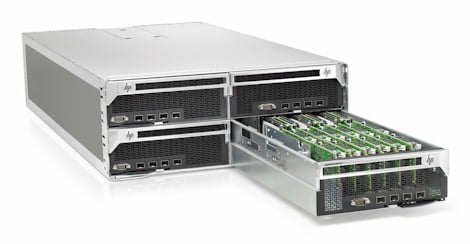
(HP Redstone ARM v7 32 bit Server, courtesy The Register)
 HP Enters the ARMs Race
In November 2011, HP released ARM RISC servers to supplement their Proliant CISC servers and Itanium LWIS processors. This was the result of "Project Moonshot".
"To make the Redstone, HP took a half-width, single-height ProLiant tray server and ripped out just about everything but the tray. In goes the passive backplane that the Calxeda EnergyCard, and HP can cram three rows of these ARM boards, with six per row, for a total of 72 server nodes, in a half-width 2U slot... That gives you 288 server nodes in a 4U rack space, or 72 servers per rack unit."
ARM CPU Manufacturers

Samsung
DRAM manufacturer, and more recently cell phone manufacturer, appears to be hiring CPU designers, possibly for the ARM CPU chips, used in Apple and their own cell phones. Various chip designers are being harvested with experience ranging from Sun Microsystems and Oracle to AMD.


Calxeda
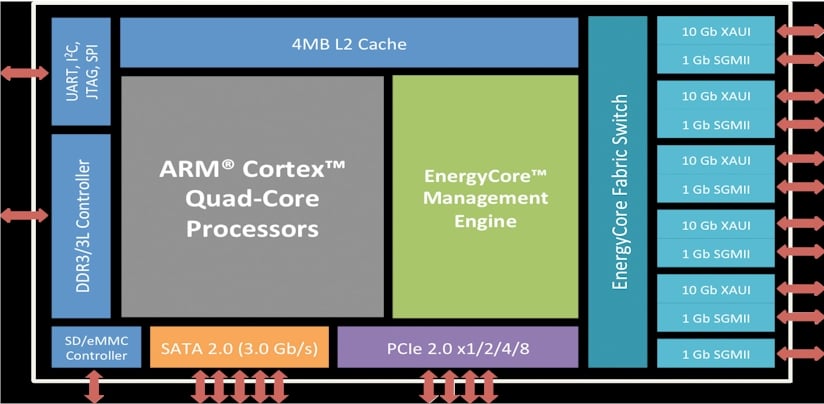
November 2011 - Calxeda announced their 32 bit quad-core EnergyCore ARM v7 EnergyCore ECX-1000 Series CPU's.
"Calxeda has spent the past several years tweaking the 32-bit ARMv7 core to come up with its own system-on-chip (SoC) and related interconnect fabric suitable for hyperscale parallel and distributed computing where nodes have only modest memory needs."

[Applied Micro CEP Paramesh Gopi, courtesty The Register]
Applied Micro
Also in October of 2011, Applied Micro announced their X-Gene 64 bit ARM v8 processors.

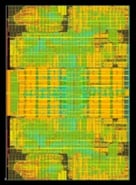
(X-Gene ARMv8 CPU)
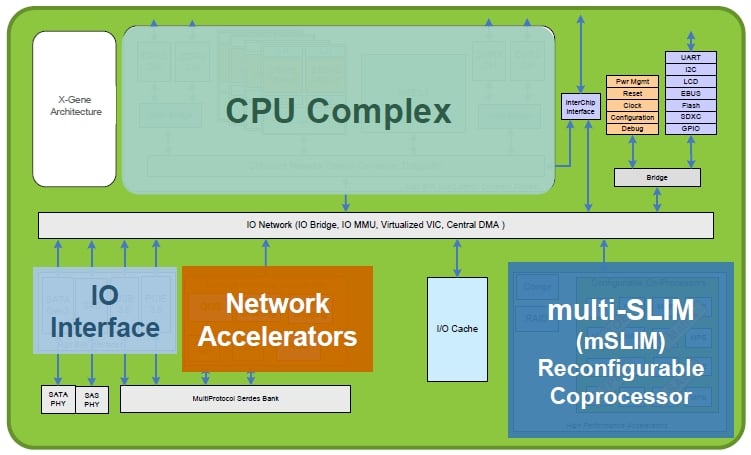
"The X-Gene chip will also include DDR3 main memory controllers, two 10 Gigabit Ethernet ports, SATA storage and PCI-Express peripheral controllers, and a power/management module – all on the same die as the cores."
"The cores will have L1 and L2 caches per core, a shared L3 cache that spans the cores, and have a target clock speed of 3GHz."
"The X-Gene chip also has on-chip CPU and I/O virtualization, just like x86, Sparc, Power, and Itanium chips do. The architecture also allows for various kinds of offload engines to be plugged in and perhaps integrated on the chip package."


(X-Gene ARM v8 Block Diagram, courtesy The Register)
The X-Gene is suposed to be ready to ship second half of 2012 - which is right about now. Taiwan Semiconductor Manufacturing Corporation (TSMC) is first etching the chips using a 40nm process, with subsequent designes in 28nm.


Nvidia
At the Las Vegas Consumer Electronics Show in April 2011, video chip processing giant Nvidea discussed phones based upon their Tegra 2 dual-core ARM Cortex-A9 chips, which bundle graphics processing, licensed the future Cortex-A15 design, and announced "Project Denver" circa 2013 - targeting desktops.
"Denver provides a choice. System builders can now choose a high-performance processor based on a RISC instruction set with modern features such as fixed-width instructions, predication, and a large general register file. These features enable advanced compiler techniques and simplify implementation, ultimately leading to higher performance and a more energy-efficient processor."
Back in September of 2010, Nvidea president and CEP Jen-Hsun Huang also discussed their "Kepler" ARM processor, due in 2011, and the "Maxwell" ARM processor due in 2013.
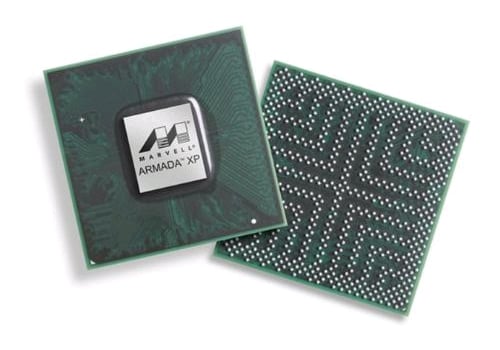
(Armada XP Processor, courtesy The Register)
Marvell

Chip manufacturer Marvell acquired the ARM RISC CPU business from Xscale in 2006. In 2010, Marvell announced it's quad-core 32 bit ARM v7 Armada XP processor, implemented on a 40nm process.
"...running at 1.6 GHz with a shared 2 MB L2 cache memory... The chip will include variants that support 64-bit DDR2, DDR3, and DDR3 low-voltage memory chips. For on-chip DDR3 controllers, the memory can run at to 800 MHz and ... has ECC memory scrubbing."
"The chip includes four PCI-Express 2.0 x4 interfaces and four Gigabit Ethernet controllers etched into its silicon; it has 16 SERDES lanes for implementing USB, PCI-Express, SATA, SGMII, and QSGMII ports..."
 It seems 2013 could prove very interesting from Marvell.
Conclusions
It is very odd, not to see IBM producing any platforms based upon ARM, but very interesting to see IBM assisting ARM to reduce it's chip process down to 14nm, back in January of 2011. One has to wonder, at what point will IBM stop developing POWER (POWER 7+ is now about 10 months late?) or stop helping ARM produce smaller & faster processors. Up until this point, POWER was not in competition with ARM, but clearly ARM is climbing the food chain, moving to thin client desktops, cell phones, tablets, and now servers.

Apple Mac OSX, based upon BSD UNIX, and Google's Android Linux are the main OS players in the ARM arena - with Microsoft starting to produce Windows ports.

OpenSolaris port to ARM was of interest back in 2009, a code contribution made in 2009, additional work in Feb/Mar 2012 timeframe with some code, Illumos developers considering ARM in March 2012, Google "Summer of Code" ARM project idea suggested in April 2012, a grad student showing interest in April 2012, and with all the activity around ARM servers - one might hope that there will be additoinal interest in the Illumos community.

Will other OS vendors port to ARM?

Thursday, May 17, 2012

HP Network Node Manager 9.10i - A Quick Analysis

HP Network Node Manager 9.10i - A Quick Analysis
Abstract:
For as long as there was communications over wires, Network Management existed. With the advent of SNMP, management could become sophisticated enough to allow for proactive management of intelligent devices and the health of various resources they managed. HP's Network Node Manager, considered "the gold standard" in network management, continues to upgrade their platform with newer features.

Key Information:
Real information on Network Node Manager is available in various datasheets and specification pages. What separates HP's Network Node Manager from the rest of the competition includes:
  • Multi-Platform Support
    Solaris, Linux, Windows, and HPUX.
    Solaris support provided for Managed-Services grade, Linux for Enterprise grade, Windows for Small-Medium Business grade network management needs.
  • Robust Performance
    Single station capable of 25,000 devices, up to 1,000,000 interfaces.
  • Robust Virtualization
    HP Network Node Manager supports Zones under Solaris - providing Solaris based Managed Service Providers with secure multi-tenancy at 0% systems overhead penalty.
  • External Authentication
    Users and Roles can be mapped to an LDAP directory
  • Excellent Device Certification Documentation
    Clear on-line documentation regarding which device and features are supported.
  • Database Support
    Embedded Postgres and third-party Oracle are both supported.
  • Multi-Tenancy Interface
    Network Node Manager old interface offered this, the new one offers this, as well.
  • Encryption and SNMPv3
    The old Network Node Manager did not offer SNMPv3 encryption, without a proxy from SNMP Research. The data sheets do not clearly indicate SNMPv3 encryption support under multi-tenancy and security.
Analysis:
Everyone who wants to be a managed services provider plays in the Linux space, but only development houses truly capable of supporting large telco environments play in the UNIX space. Solaris is the dominate market leader, with more installations than IBM AIX and HP-UX combined, but HP-UX is still supported (for the time being - their Itanium based HP-UX platform is at-risk.)

Scalability of 25K devices with 1M interfaces is a terrific improvement, over the old days of HP Network Node Manager. The older NNM platforms seemed to become sluggish between 1,000 and 2,000 devices. Modern day telco managed services engagements regularly deal with multiple core devices have 1,000,000 interfaces per core device (not to mention end-points) - which this writer was able to do a half-decade ago with EMC Ionix on an old 8 socket UltraSPARC IV platform (as well as other customers.) Running a separate NNM instance for every internal core device is completely unrealistic. Most people do not consider the vertical scalability needs of network management tools - single customers with large interface counts MUST support large socket counts on UNIX systems like Solaris and HP-UX to meet the business requirements.

With 0-overhead virtualization technologies like Solaris Zones, Node Manager is able to play "in the big leagues" with managed service providers, to provide simplistic multi-tenant solutions where overlapping ip addresses must be managed. Each Solaris Zone can route to a different customer, with identical IP Addresses - with no cost in system resources, since Solaris Zones all share the same kernel resources.

Authentication of users to an external LDAP directory provides for Single Sign-On capabilities and resolves a variety of issues with auditing requirements, password changing issues, locking out users who are no longer with the service provider, etc.

It is critical for a managed services organization to understand whether a device can be monitored and managed. Clear documentation, which is available for the world to see, provides that kind of feedback to the community, to level-set expectations with telco providers to communicate to joint customers.

Embedded Postgres and third-party Oracle are both supported, the former for service providers to avoid Oracle service provider fees, the latter for enterprises with few DBA  resources to provide singular database support across an entire enterprise.

Multi-Tenant requirements are tremendously diverse. The new web interface offers configuration, like the old X-Windows interface, but the data-sheets are strangely silent about SNMPv3 support - an absolute minimum for dealing with multi-tenancy, so customers know their data is secure during the traversal of shared networks. Any security minded individual be concerned about support or robustness of support of SNMPv3 by this product.

Additional Information
See the SNMP Resources Tab on the Network Management Blog for more information.

Tuesday, May 1, 2012

Processors for: AIX, HP-UX, and Solaris

Abstract:
With the delay and loss of single-vendor advocated central processor units, operating systems centered on that silicon are considered not necessary. Application vendors dependent upon a single operating system dependent upon a single underlying architecture are even at higher risk. This article discusses the top 3 UNIX vendors with the impact of their silicon trajectory.

[Rumored IBM Power 7+ Multi-Chip-Modules, courtesy softpedia]
IBM POWER 7+ Now 7 Months Late: AIX in the Crosshairs

It was reported last month that IBM POWER 7+ was delayed about 6 months. As of this date, POWER 7+ is now 7 months late. A little insight from the IT Jungle from end of January:
This year, IBM is also supposed to add support for Power7+ machinery to the SDMC, which presumably implies that Power7+ processors are coming out sometime this year.
Maybe 7 months for IBM POWER 7+ is enough?
Will IBM POWER 8 be mentioned 8 months after POWER 7+ was late?

Of course, the dominant operating system on single-supplier IBM POWER is IBM AIX. The delay single-supplier of POWER impacts single-supplier IBM AIX. Linux may also run under POWER, but Linux is not the reason POWER exists.

Applications locked-into IBM AIX on IBM POWER must wait. Applications compiled for IBM POWER under Linux must also wait. If an business application needs more power, one must wait on POWER.


[Intel Itanium, courtesy xbitlabs]
Intel Itanium End: End of HP-UX
The Web Logic Development Journal listed some HP statements during the Oracle-HP court case:
  • HP did not want to reveal that the Itanium road map is "more an illusion than of technical significance."
  • Its purpose was to "extend the Itanium roadmap... to create market perception of long term viability."
  • "HP-UX is on a death march due to inevitable Itanium trajectory."
  • That HP knew that customers are prone to abandon a server technology as soon as its end of life becomes "visible"
  • HP's internal documents show that "the Itanium situation is one of our most closely guarded secrets."
  • "The regions are unaware of the situation with Itanium and the impending end of life."
  • The last Itanium chip, Kittson plus, is released in a throttled down version and then a full version to create "illusion" of longer roadmap.
The end-of-life for (single supplier) Intel Itanium is not a surprise, but the court statements are interesting.

In November of 2011, 3000newswire discussed Project Odyssey, HP's delivering HP-UX features to only Linux and Windows.
"Unfortunately project Odyssey will ultimately drive most companies to IBM's AIX. [HP-UX] features on Linux are desirable, but Odyssey won't get many customers to migrate to Linux. I think it is very interesting that only Linux and Windows are supported.
Clearly, HP-UX is on the ropes. The [court document revealed] death of Intel Itanium co-insides with HP pushing users off HP-UX and Itanium. With Oracle shutting down Itanium software development, the death of Windows on Itanium, death of Red Hat Linux on Itanium - the push off of Itanium's sole remaining HP-UX operating system is not unusual.

[Oracle SPARC T4 Processor]
Multi-Vendor SPARC: Solaris Diversity Thrives
Customer dependent upon IBM POWER or Intel Itanium are locked into those vendors and their single source operating systems (i.e. IBM AIX and HP-UX)  as discussed earlier. The death-march by customers dependent upon those operating systems is uneasy. As single vendor CPU suppliers silently delay, operating system vendors tie their customer's fortunes to those single suppliers. Operating systems tied to single CPU vendors are even more at risk.

In the SPARC community, things is vastly different. SPARC is a specification, multiple commercial vendors build SPARC processors and systems, anyone can choose to make their own SPARC chips without going to existing vendors, there is no legal risk for additional vendors to building SPARC processors, and multiple operating systems by multiple profitable vendors exist for processor support.

Commercial SPARC vendors include: Oracle, Fujitsu. Fujitsu has the most diverse lines, including: Throughput, Mainframe, and SuperComputer SPARC models. Commercial operating system support for SPARC includes: Solaris, Linux. Solaris CPU support include: Fujitsu SPARC, Oracle SPARC, Intel x64, AMD x64. Solaris family OS vendors include: Fujitsu, Oracle, Joyent, Nexenta. Solaris based Open-Source distributions include: SmartOS, OpenIndiana, Illumian. Solaris source code trees include: Closed Source Oracle Solaris, Open Source snapshots of OpenSolaris; active Open Source Illumos.

Oracle released a 4 part virtual seminar on the Solaris 11 road map (note: published comments on Session 1.) With new processors from Fujitsu and Oracle being released (seemingly yearly) and diversification of Solaris under all major commodity processors - it feels like the 1990's, with the launch of the Internet, all over again!