Thursday, November 3, 2011

Virtual Classroom: SPARC T4 Series


Virtual Classroom: SPARC T4 Series

Abstract:
The Information Technology world seems to keep moving, with new developments coming after old. Some cooporative efforts, such as the SPARC community, offer new opportunities from various vendors to compete while the user community reaps the benefits of the varied development tracks. Oracle released the T4 processor a matter of weeks ago. Oracle is presenting in their Virtual Classroom the Next Generation SPARC T4 Systems on Wednesday, November 9, 2011 at 11:00 am PT or 2:00 pm ET.

Summary:
Oracle’s SPARC T4 servers running Oracle Solaris delivers world record performance on a highly scalable secure and integrated platform optimized for enterprise software. With a 5x improvement in single-thread performance, 1TB of memory capacity, and massive system throughput and I/O capacity, the SPARC T4 is ideal for large scale applications, enterprise-wide consolidation and database projects that require extreme reliability, availability and security.

Details:
Oracle provided a basic overview SPARC T4 systems information. Some key features in Oracle's SPARC T4 servers include:


  • Built-in Virtualization with Live Migration

  • On-chip Cryptographic Acceleration

  • Dynamic Threads
Register to participate in the virtual classroom.

Wednesday, November 2, 2011

DTrace: Real Visibility


DTrace: Real Visibility

Abstract:
DTrace was developed by engineers from Sun Microsystems, and leveraged in their Fishworks project, to provide instrumentation for their Solaris 11 based storage system. After many of the original developers were cut from the staff, during the acquisition by Oracle, the DTrace community continued to significant diversify. Real visibility, to running applications and operating systems, is now reaching critical mass through the DTrace diaspora.


Oracle Announcement:
Oracle announced in Cotober 2011 that DTrace was being brought to Oracle Enterprise Linux. This announcement generated much discussion, but the history is fairly significant.

Some History:
There will be no attempt to provide an exhaustive history, but it is important to "travel down the roads least traveled" to gain an understanding of DTrace.

June 17, 2004 - Sun's Adam Leventhal starts work with Solaris DTrace
December 13, 2005 - Sun's Adam Leventhal discusses Solaris DTrace in a Linux Branded Zone
March 3, 2007 - Mailing list discussions regarding DTrace port to FreeBSD
August 2, 2007 - Sun's Adam Leventhal discusses knock-off DTrace copy on Linux
August 6, 2007 - Sun's Adam Leventhal discusses DTrace port to Linux
April 3, 2008 - Crisp developer Paul Fox starts DTrace port to Linux
June 30, 2008 - Sun's Adam Leventhal discusses a firestorm regarding DTrace port to Linux
August 10, 2010 - Oracle's Adam Leventhal departs and joins Delphix
September 23, 2010 - Oracle's Brendan Greg discusses upcoming DTrace Book
October 25, 2010 - Oracle's DTrace developer Brendan Greg departs for Joyent
November 19, 2010 - Oracle's Darren Moffat uses DTrace to better understand ZFS encryption
October 4, 2011 - Oracle announces DTrace for Oracle Enterprise Linux
October 5, 2011 - Delphix's Adam Leventhal discusses Oracle Linux DTrace alpha-beta
October 10, 2o11 - Delphix's Adam Leventhal discusses Oracle Linux DTrace Port issues
October 11, 2011 - Oracle's Wim Coekaerts "kicks the tires" on Oracle Linux DTrace
October 14, 2011 - Crisp developer Paul Fox discusses his DTrace Ubunto 11.10 port

Tuesday, November 1, 2011

Solaris 11: Launch Event


Solaris 11: Launch Event

Abstract:
SVR4 UNIX and later Solaris has been the Gold Standard in telecommunication infrastructure for decades. The latest release of Solaris is about to be launched.

Details:
Don't miss the launch on November 9, 2011 of Solaris 11!

[html] November 9, 2011 - Oracle Solaris 11 Launch Event

Wednesday, November 09, 2011
10 a.m. – 1 p.m. ET

Gotham Hall
1356 Broadway at 36th Street
New York, NY 10018

Tuesday, October 18, 2011

OracleWorld: Some Presentations


OracleWorld: Some Presentations

For those of you who missed Oracle OpenWorld, these may be of interest to Network Management and Telephone Infrastructure Carrier Providers.

A variety of presentations occurred at Oracle OpenWorld 2011:
[html] 2011-10 - Oracle Openworld Blog

[html] 2011-10-05 - Larry Ellison Keynote
Oracle Openworld 2011
Live Streaming and Recorded

[html] 2011-10-11 - Oracle Sun ZFS Storage Appliance Launch
Phil Bullinger, Senior Vice President of Storage

[html] 2011-08-29 - Oracle SunBlade 6000 Modular System - Introduction
Marc Shelley, Senior Manager, Sun Blade Management Team

[html] 2011-08-29 - Oracle SunBlade 6000 Modular System - Front Chassis
Marc Shelley, Senior Manager, Sun Blade Management Team

[html] 2011-08-29 - Oracle SunBlade 6000 Modular System - Rear Chassis
Marc Shelley, Senior Manager, Sun Blade Management Team

[pdf] 2011-10 - SPARC Strategy
Masood Heydari, Senior Vice President, SPARC Systems Development

[pdf] 2011-10 - Next Generation SPARC Processor
An In-Depth Technical Review
Rick Hetherington, Vice President of Microelectronics
Greg Grohoski, Senior Director of Microelectronics

[pdf] 2011-10 - An Oracle White Paper
Oracle's SPARC T4-1, SPARC T4-2, SPARC T4-4, and SPARC T4-1B Server Architecture

Sunday, October 16, 2011

ZFS: A Multi-Year Case Study in Moving From Desktop Mirroring (Part 2)


Abstract:
ZFS was created by Sun Microsystems to innovate the storage subsystem of computing systems by simultaneously expanding capacity & security exponentially while collapsing the formerly striated layers of storage (i.e. volume managers, file systems, RAID, etc.) into a single layer in order to deliver capabilities that would normally be very complex to achieve. One such innovation introduced in ZFS was the ability to provide inexpensive limited life solid state storage (FLASH media) which may offer fast (or at least greater deterministic) random read or write access to the storage hierarchy in a place where it can enhance performance of less deterministic rotating media. This paper discusses the use of various configurations of inexpensive flash to enhance the write performance of high capacity yet low cost mirrored external media with ZFS.

Case Study:
A particular Media Design House had formerly used multiple external mirrored storage on desktops as well as racks of archived optical media in order to meet their storage requirements. A pair of (formerly high-end) 400 Gigabyte Firewire drives lost a drive. An additional pair of (formerly high-end) 500 Gigabyte Firewire drives experienced a drive loss within one month later. A media wall of CD's and DVD's was getting cumbersome to retain.

First Upgrade:
A newer version of Solaris 10 was released, which included more recent features. The Media House was pleased to accept Update 8, with the possibility of supporting Level 2 ARC for increased read performance and Intent Logging for increase write performance.

The Media House did not see the need to purchase flash for read or write logging at this time. The mirrored 1.5 Terabyte SAN performed adequately.


Second Upgrade:
The Media House started becoming concerned, about 1 year later, when 65% of their 1.5 Terabyte SAN storage was burned through.
Ultra60/root# zpool list

NAME     SIZE   USED  AVAIL    CAP  HEALTH  ALTROOT
zpool2  1.36T   905G   487G    65%  ONLINE  -
The decision to invest in an additional pair of 2 Terabyte drives for the SAN was an easy one. The external Seagate Expansion drives were selected, because of the reliability of the former drives, and the built in power management which would reduce power consumption.

Additional storage was purchased for the network, but if there was going to be an upgrade, a major question included: what kind of common flash media would perform best for the investment?


Multiple Flash Sticks or Solid State Disk?

Understanding that Flash Media normally has a high Write latency, the question in everyone's mind is: what would perform better, an army of flash sticks or a solid state disk?

This simple question started what became a testing rat hole where people ask the question but often the responses comes from anecdotal assumptions. The media house was interested in the real answer.

Testing Methodology

It was decided that the copying of large files to/from large drive pairs was the most accurate way to simulate the day to day operations of the design house. This is what they do with media files, so this is how the storage should be tested.

The first set of tests surrounded testing the write cache in different configurations.
  • The USB sticks would each use a dedicated 400Mbit port
  • USB stick mirroring would occur across 2 different PCI buses
  • 4x consumer grade 8 Gigabyte USB sticks from MicroCenter were procured
  • Approximately 900 Gigabytes of data would be copied during each test run
  • The same source mirror was used: the 1.5TB mirror
  • The same destination mirror would be used: the 2TB mirror
  • The same Ultra60 Creator 3D with dial 450MHz processors would be used
  • The SAN platform was maxed out at 2 GB of ECC RAM
  • The destination drives would be destroyed and re-mirrored between tests
  • Solaris 10 Update 8 would be used
The Base System
# Check patch release
Ultra60/root# uname -a
SunOS Ultra60 5.10 Generic_141444-09 sun4u sparc sun4u


# check OS release
Ultra60/root# cat /etc/release
Solaris 10 10/09 s10s_u8wos_08a SPARC
Copyright 2009 Sun Microsystems, Inc. All Rights Reserved.
Use is subject to license terms.
Assembled 16 September 2009


# check memory size
Ultra60/root# prtconf | grep Memory
Memory size: 2048 Megabytes


# status of zpool, show devices
Ultra60/root# zpool status zpool2
pool: zpool2
state: ONLINE
scrub: none requested
config:

NAME STATE READ WRITE CKSUM
zpool2 ONLINE 0 0 0
mirror ONLINE 0 0 0
c4t0d0s0 ONLINE 0 0 0
c5t0d0s0 ONLINE 0 0 0

errors: No known data errors
The Base Test: No Write Cache

A standard needed to be created by which each additional run could be tested against. This base test was a straight create and copy.

ZFS is a tremendously fast system for creating a mirrored pool under. A 2TB mirrored poll takes only 4 seconds on an old dual 450MHz UltraSPARC II.
# Create mirrored pool of 2x 2.0TB drives
Ultra60/root# time zpool create -m /u003 zpool3 mirror c8t0d0 c9t0d0

real 0m4.09s
user 0m0.74s
sys 0m0.75s
The data to be copied with source and destination storage is easily listed.
# show source and destination zpools
Ultra60/root# zpool list
NAME SIZE USED AVAIL CAP HEALTH ALTROOT
zpool2 1.36T 905G 487G 65% ONLINE -
zpool3 1.81T 85.5K 1.81T 0% ONLINE -

The copy of over 900 GB between mirrored USB pairs takes about 41 hours.
# perform copy of 905GBytes of data from old source to new destination zpool
Ultra60/root# cd /u002 ; time cp -r . /u003
real 41h6m14.98s
user 0m47.54s
sys 5h36m59.29s
The time to destroy the 2 TB mirrored pool holding 900GB of data was about 2 seconds.
# erase and unmount new destination zpool
Ultra60/root# time zpool destroy zpool3
real 0m2.19s
user 0m0.02s
sys 0m0.14s
Another Base Test: Quad Mirrored Write Cache

The ZFS Intent Log can be split from the mirror onto higher throughput media, for the purpose of speeding writes. Because this is a write cache, it is extremely important that this media is redundant - a loss to the write cache can result in a corrupt pool and loss of data.

The first test was to create a quad mirrored write cache. With 2 GB of RAM, there is absolutely no way that the quad 8 GB sticks would ever have more than a fraction flash used, but the hope is that such a small amount of flash used would allow the commodity sticks to perform well.

The 4x 8GB sticks were inserted into the system, they were found, formatted (see this article for additional USB stick handling under Solaris 10), and the system was now ready to accept them for creating a new destination pool.

Creation of 4x mirror ZFS Intent Log with 2TB mirror took longer - 20 seconds.
# Create mirrored pool with 4x 8GB USB sticks for ZIL for highest reliability
Ultra60/root# time zpool create -m /u003 zpool3 \
mirror c8t0d0 c9t0d0 \
log mirror c1t0d0s0 c2t0d0s0 c6t0d0s0 c7t0d0s0
real 0m20.01s
user 0m0.77s
sys 0m1.36s
The new zpool is clearly composed of a 4 way mirror.
# status of zpool, show devices
Ultra60/root# zpool status zpool3
pool: zpool3
state: ONLINE
scrub: none requested
config:

NAME STATE READ WRITE CKSUM
zpool3 ONLINE 0 0 0
mirror ONLINE 0 0 0
c8t0d0 ONLINE 0 0 0
c9t0d0 ONLINE 0 0 0
logs
mirror ONLINE 0 0 0
c1t0d0s0 ONLINE 0 0 0
c2t0d0s0 ONLINE 0 0 0
c6t0d0s0 ONLINE 0 0 0
c7t0d0s0 ONLINE 0 0 0

errors: No known data errors
No copy was done using the quad mirrored USB ZIL, because this level of redundancy was not needed.

A destroy of the 4 way mirrored ZIL with 2TB mirrored zpool still only took 2 seconds.

# destroy zpool3 to create without mirror for highest throughput
Ultra60/root# time zpool destroy zpool3
real 0m2.19s
user 0m0.02s
sys 0m0.14s
The intention of this setup was just to see if it was possible, ensure the USB sticks were functioning, and determine if adding an unreasonable amount of redundant ZIL to the system created any odd performance behaviors. Clearly, if this is acceptable, nearly every other realistic scenario that is tried will be fine.

Scenario One: 4x Striped USB Stick ZIL

The first scenario to test will be the 4-way striped USB Stick ZFS Intent Log. With 4 USB sticks, 2 sticks on each PCI bus, each stick on a dedicated USB 2.0 port - this should offer the greatest amount of throughput from these commodity flash sticks, but the least amount of security from a failed stick.
# Create zpool without mirror to round-robin USB sticks for highest throughput (dangerous)
Ultra60/root# time zpool create -m /u003 zpool3 \
mirror c8t0d0 c9t0d0 \
log c1t0d0s0 c2t0d0s0 c6t0d0s0 c7t0d0s0
real 0m19.17s
user 0m0.76s
sys 0m1.37s

# list zpools
Ultra60/root# zpool list
NAME SIZE USED AVAIL CAP HEALTH ALTROOT
zpool2 1.36T 905G 487G 65% ONLINE -
zpool3 1.81T 87K 1.81T 0% ONLINE -


# show status of zpool including devices
Ultra60/root# zpool status zpool3
pool: zpool3
state: ONLINE
scrub: none requested
config:
NAME STATE READ WRITE CKSUM
zpool3 ONLINE 0 0 0
mirror ONLINE 0 0 0
c8t0d0 ONLINE 0 0 0
c9t0d0 ONLINE 0 0 0
logs
c1t0d0s0 ONLINE 0 0 0
c2t0d0s0 ONLINE 0 0 0
c6t0d0s0 ONLINE 0 0 0
c7t0d0s0 ONLINE 0 0 0
errors: No known data errors


# start copy of 905GB of data from mirrored 1.5TB to 2.0TB
Ultra60/root# cd /u002 ; time cp -r . /u003
real 37h12m43.54s
user 0m49.27s
sys 5h30m53.29s

# destroy it again for new test
Ultra60/root# time zpool destroy zpool3
real 0m2.77s
user 0m0.02s
sys 0m0.56s
The zpool creation was 19 seconds, destroying almost 3 seconds, but the copy decreased from 41 to 37 hours or about 10% savings... with no redundancy.

Scenario Two: 2x Mirrored USB ZIL on 2TB Mirrored Pool

Adding quad mirrored ZIL offered a 10% boost with no redundancy, what if we added a pair of mirrored USB ZIL sticks, to offer write striping for speed and mirroring for redundancy?
# create zpool3 with pair of mirrored intent USB intent logs
Ultra60/root# time zpool create -m /u003 zpool3 mirror c8t0d0 c9t0d0 \
log mirror c1t0d0s0 c2t0d0s0 mirror c6t0d0s0 c7t0d0s0
real 0m19.20s
user 0m0.79s
sys 0m1.34s

# view new pool with pair of mirrored intent logs
Ultra60/root# zpool status zpool3
pool: zpool3
state: ONLINE
scrub: none requested
config:
NAME STATE READ WRITE CKSUM
zpool3 ONLINE 0 0 0
mirror ONLINE 0 0 0
c8t0d0 ONLINE 0 0 0
c9t0d0 ONLINE 0 0 0
logs
mirror ONLINE 0 0 0
c1t0d0s0 ONLINE 0 0 0
c2t0d0s0 ONLINE 0 0 0
mirror ONLINE 0 0 0
c6t0d0s0 ONLINE 0 0 0
c7t0d0s0 ONLINE 0 0 0
errors: No known data errors

# run capacity test
Ultra60/root# cd /u002 ; time cp -r . /u003
real 37h9m52.78s
user 0m48.88s
sys 5h31m30.28s


# destroy it again for new test
Ultra60/root# time zpool destroy zpool3
real 0m21.99s
user 0m0.02s
sys 0m0.31s
The results were almost identical. A 10% improvement in speed was measured. Splitting the commodity 8GB USB sticks into a mirror offered redundancy without lacking performance.

If 4 USB sticks are to be purchased for ZIL, don't bother striping all 4, split them into mirrored pairs and get your 10% boost in speed.


Scenario Three: Vertex OCZ Solid State Disk

Purchasing 4 USB sticks for the purpose of a ZIL starts to approach the purchase price of a fast SATA SSD drive. On the UltraSPARC II processors, the drivers for SATA are lacking, so that is not necessarily a clear option.

The decision test a USB to SATA conversion kit with the SSD and run a single SSD SIL was made.
# new flash disk, format
Ultra60/root# format -e
Searching for disks...done
AVAILABLE DISK SELECTIONS:
...
2. c1t0d0
/pci@1f,2000/usb@1,2/storage@4/disk@0,0
...


# create zpool3 with SATA-to-USB flash disk intent USB intent log
Ultra60/root# time zpool create -m /u003 zpool3 mirror c8t0d0 c9t0d0 log c1t0d0
real 0m5.07s
user 0m0.74s
sys 0m1.15s
# show zpool3 with intent log
Ultra60/root# zpool status zpool3
  pool: zpool3
 state: ONLINE
 scrub: none requested
config:

        NAME        STATE     READ WRITE CKSUM
        zpool3      ONLINE       0     0     0
          mirror    ONLINE       0     0     0
            c8t0d0  ONLINE       0     0     0
            c9t0d0  ONLINE       0     0     0
        logs
          c1t0d0    ONLINE       0     0     0

# run capacity test
Ultra60/root# cd /u002 ; time cp -r . /u003
real 32h57m40.99s
user 0m52.04s
sys 5h43m13.31s
The single SSD over a SATA to USB interface provided a 20% boost in throughput.

In Conclusion

Using commodity parts, a ZFS SAN can have the write performance boosted using USB sticks by 10% as well as by 20% using an SSD. The SSD is a more reliable device and better choice for ZIL.

Thursday, October 13, 2011

Death of Two Titans: Jobs and Ritchie

The Mac Observer published last week:
U.S. President Barack Obama issued a statement on the passing of Steve Jobs Wednesday calling the Apple cofounder one of America’s greatest innovators. Mr. Jobs passed away sometime on Wednesday, an event that had lead to many luminaries offering statements and remembrances about the iconic executive. The president, an iPad user, also praised Mr. Jobs for having, “changed the way each of us sees the world.”

[Steve Jobs]

Steve Jobs was famous for the creation of Apple Computer with the Apple II and Macintosh, as well as popular consumer electronics like the iPod, iPhone, and iPad.

Electronista publishes today:
Just one week after the tech industry was hit with the news of Steve Jobs' death, computer scientist Dennis Ritchie​ has also passed. The unfortunate news was announced by friend and colleague Rob Pike​, who notes that Ritchie died at his home after a "long illness." The 70-year-old Harvard graduate and veteran of Lucent Technologies and Bell Labs​ was credited with authoring the C programming language.

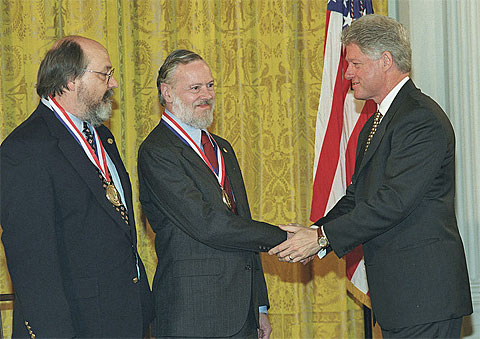
Dennis Ritchie published the book "The C Programming Language" in 1978 with Brian Kernighan​, after the C Language was developed at Bell Labs. The language is often referred to as "K&R C". This language was also used in the development of the UNIX Operating System with Ken Thompson.


[President Clinton awarding National Medal of Technology in 1998 to Dennis Ritchie and Ken Thompson]

Nearly all modern operating systems are now based upon C. These three are the grandfathers of modern computers. Even Steve Job's Macintosh Operating System, MacOS X, is based on UNIX and C.


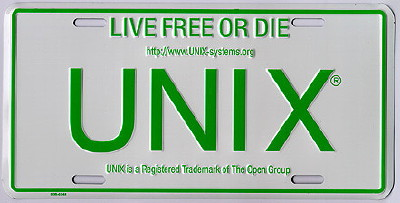
I could never give justice to the likes of Steve Jobs or Dennis Ritchie in this blog, but at least I can reference them. Unlike the license place, they "lived free and died - UNIX".

May God rest their souls, which longed for excellence and perfection.

Wednesday, October 12, 2011

RIM: Unbelievably Down, Unbelievably Long


RIM: Unbelievably Down, Unbelievably Long
Abstract:


Sun had a saying "The Network is The Computer". When a network is down, the computer is nearly useless. RIM is now experiencing "The Network is The BlackBerry". The BlackBerry is pretty much useless without the network. The impact to the market may be terrible.

A Short History:

Apple had made an attempt to build a "Personal Digital Assistant" market in 1987. The "Newton" seemed to target educators and students. Some other vendors released competing products, but none of them seem to be successful. It was a product "before it's time".

In 1996, U.S. Robotics created the "Palm Pilot", new digital assistant. This became successful, the technology moved to 3Com, Handspring, Palm.

Nokia started the merging of personal digital assistant software into the phone in the late 1990's, later on with some weak web browsing capability. Nokia cobbled together their phone with HP's software. The term "smart phone" was created. Ericson released a concept PDA and phone in 1997 with the eventual culmination of a touchscreen "smartphone" in 2000. The phone used the SymbianOS.


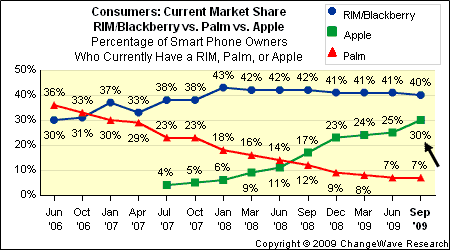
[2008-2009 Market Trend]

RIM seems to have virtually created the "smart phone" market in 1999. The merging of digital personal assistant and cell phone seemed to drive their success. Their primary target community was business and financial segments, who could afford an uplifted phone cost for the side benefit of becoming more efficient. The product offering was a success.


[2006-2009 Market Trend]

In the early 2000's, Palm released a merged their personal digital assistant with cell phone technology. The "smart phone" market had a new competitor. Eventually, the technology was purchased by HP, where it resides today.

[2009-2010 Market Trend]

Apple computer started designing the iPhone in 2005 and released it in January 2007. Their new "smart phone" (i.e. iPhone), which was speculated to be a "flop" since it did not come with a keyboard. The product targeted the "creative" and "youth" segments, merging functionality from their wildly popular iPod portable music & video playing devices. Also bundled was the first real web browser - until this point, internet HTTP experience was poor. The product offering was a success and placed pressure on RIM by slowly intruding into the business and financial sectors, while other vendors (like Palm and Microsoft) were getting devastated.


[2010-2011 Market Trend]

Google started a parallel track to Apple. They purchased Android, Inc in late 2005 and eventually released an operating system called "Android" in late 2007, after the wildly successful Apple iPhone introduction earlier that year. Phone manufacturers jumped on-board Android, trying to get a chunk of the "smart phone" market, without the heavy investment and innovation performed by companies like Palm, RIM, and Apple.


Cell phone giant, Nokia, had been losing market share. Microsoft had been losing marketshare in the mobile phone operating system market. These two shrinking titans agreed in April 2011 to combine forces - Nokia providing hardware with Microsoft's OS. It could stem the bleeding from both companies or the two shrinking titans might become one sinking titanics.

The Nightmare Scenario

RIM had "secret sauce" embedded into it's BlackBerry communicator - all communciation from their phones were carried over their network infrastructure, in addition to the telephone carrier's infrastructure. RIM's encrypted network allowed them to provide add-on services, as well as security to their business users.

This week, there has been a multi-day outage for BlackBerry users, across the globe. The problem was with a switch in THEIR INFRASTRUCTURE - which means it is not the fault of a telephone company. Only BlackBerry users are affected - while the rest of the SmartPhone market is unaffected.

Don't Lie To The Customer

RIM's "secret sauce" is appearing to be their "achilles heel". Without RIM and their network, the BlackBerry is pretty much useless.

This very week, there is BlackBerry training happening in my corporate headquarters, and when questions regarding the BlackBerry difficulties came up - the trainer said "there must be something wrong with your company's network."

The truth is not only out, but it appears the issue is isolated to THEIR customer network.

Bad Discusssions

When investors and analysts start to talk about situations like these, the language does not get any worse than this.
Jefferies analyst Peter Misek crushed RIM in a research note today. His memo to activists was that RIM's turnaround will take a long time...

Specifically, Misek said that RIM can't be broken up until its migration to QNX is complete in roughly six months. Meanwhile, a management change is difficult. Motorola Mobility CEO Sanjay Jha would be a candidate to lead RIM, but he's highly thought of at Google. Other executives at Apple and Microsoft are largely locked up from going to RIM. PC makers, smartphone rivals, and other takeover options look slim.

Add it up and RIM's only real option at the moment is to execute well and bolster momentum for the BlackBerry. The outages aren't helping that cause.

Surviving because there are no other options on the table when investors are thinking about chopping your comany up into little pieces it not a good place to be.


When Sharks Attack

During this very week, Apple had announced their long-anticipated iPhone 4S, a faster SmartPhone with build-in "Cloud Syncronization" - Apple will no longer require a user to have a computer in order to keep their phones backed up or syncronized with music. Apple's phone will no longer require Apple or a PC in order to get the full functionality of it. Apple's open-sourced MacOSX based iPhone was poised for serious growth, without the BlackBerry disaster.

Google is about to feed the market, with it's army of hardware manufacturers, with more open-sourced Android phones while sinking-faster-than-a-brick Nokia and Microsoft are trying to establish a new marketplace with Microsoft's closed-source operating system. Microsoft, with their business relationships, may actually float Nokia, with this unfortunate BlackBerry disaster.

This will surely be a feeding frenzy for the three major remaining phone operating system vendors.


Bad for the Free Market

The Free Market is all about choice - the loss of any major competitor in the market is bad for all of the consumers.

One might argue that RIM's "monopoly" of providing THE centralized infrastructure for all BlackBerries to traverse is the due penalty for their anti-capitalistic tendencies... and their customers deserve what they get for placing all their "eggs in one basket".

This author is not interested in seeing the diverse market competitors become centralized, since the evil is self-evident, it is dangerous for innovation. There must be freedom to innovate in the highly government regulated market of telecommunications.

Network Management

The probable decline of RIM is due to one massive network infrastructure error.

Had their network been better managed, their future decline may not be so sure.

It is possible that they will recover, but I would hate to be in that company today, and I would hate to be the team managing that network today.

The network is the rise and fall of a company - don't mis-manage your network.